How to fold an origami gift box (masu box with lid)
One square of paper, no glue and about ten folds: how to make a classic masu box and lid, what size paper to use and what to tuck inside.
Quick answer
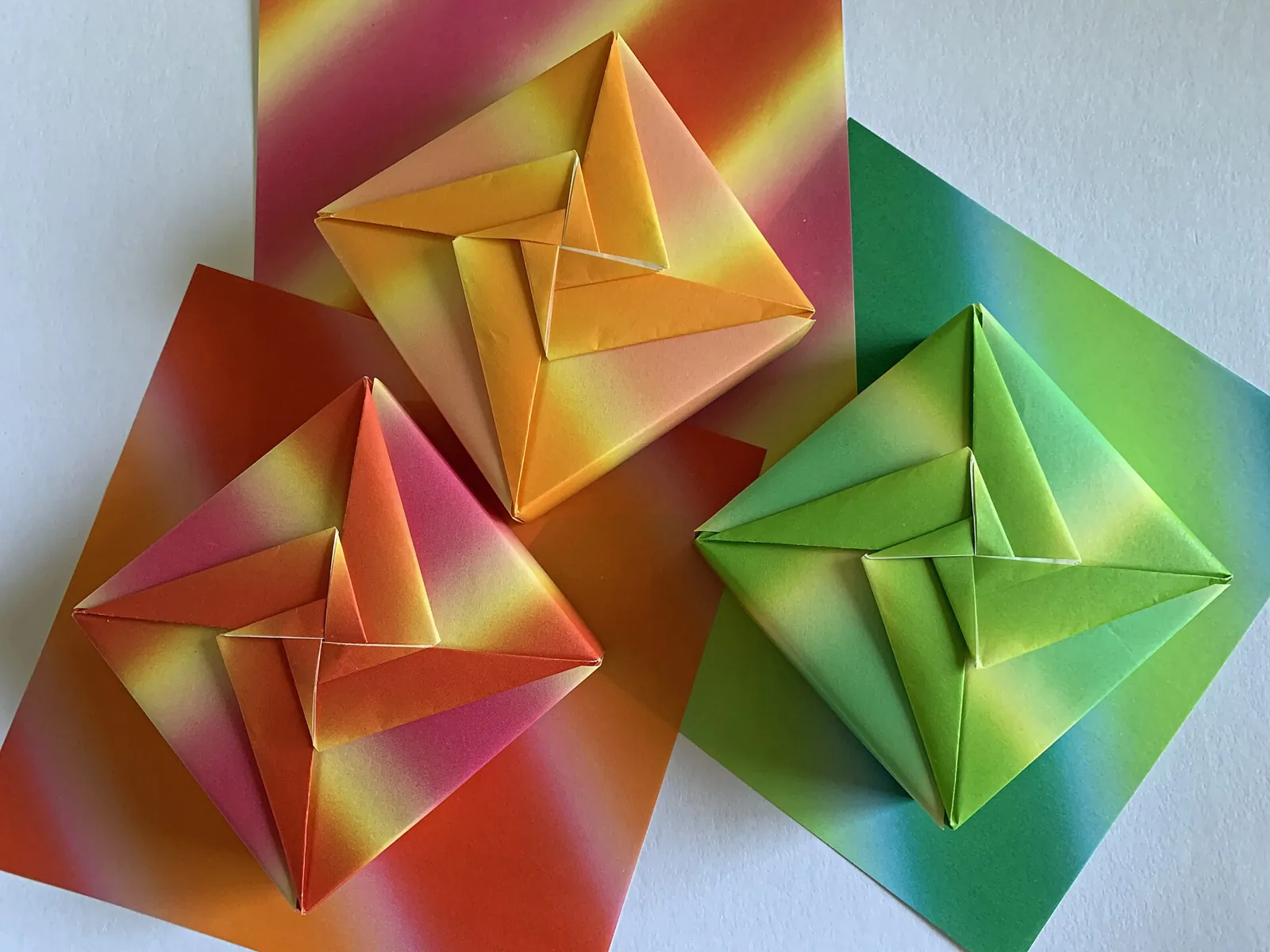
The classic origami gift box is the masu box: one square of paper, no glue, about ten folds. Crease both diagonals, fold all four corners to the center, crease the edges to the middle, open two corners, raise the walls and lock the points inside. Fold a lid from a square about ¼ inch (6 mm) larger. A 12-inch square makes a box roughly 4¼ inches across, big enough for jewelry, truffles or a gift card.
- Time 10 – 15 minutes per box with lid
- Difficulty Beginner
- Cost $5 – $15 for a pack of paper
- Makes One lidded square box, no glue or tape
A folded box turns a small gift into something people keep. The masu box takes its name from a traditional square wooden box once used in Japan to measure rice and still used today for serving sake, and the paper version is one of the most widely taught origami models because it is sturdy, holds its shape without glue and nests neatly with a lid. Once you have folded it twice, you can make a whole set from leftover wrapping paper in an evening.
Materials
- Two squares of paper: one for the base and one about ¼ in (6 mm) larger for the lid
- Good papers: origami paper (kami), scrapbook paper, wrapping paper, or pages from an old map or calendar
- A bone folder or the edge of a ruler for sharp creases (optional)
- Paper trimmer or scissors and a ruler to cut accurate squares
- Optional: tissue paper or a cupcake liner to line the box, ribbon or washi tape
How big will the box be?
The finished masu box is about 0.35 times the width of the starting square, and about half that tall. Accuracy matters more than size, so start with a perfectly square sheet.
| Square of paper | Box width (approx.) | Box height (approx.) |
|---|---|---|
| 6 in (15 cm) | 2⅛ in (5.3 cm) | 1 in (2.6 cm) |
| 8 in (20 cm) | 2⅞ in (7.1 cm) | 1⅜ in (3.5 cm) |
| 12 in (30.5 cm) | 4¼ in (10.8 cm) | 2⅛ in (5.4 cm) |
Tip: To cut a square from a rectangle, fold one short edge down to meet the long edge to form a triangle, crease, and cut off the leftover strip.
How to fold a masu box
Crease both diagonals
Place the paper colored side down. Fold it corner to corner, crease, unfold, and repeat in the other direction. You now have an X marking the center.
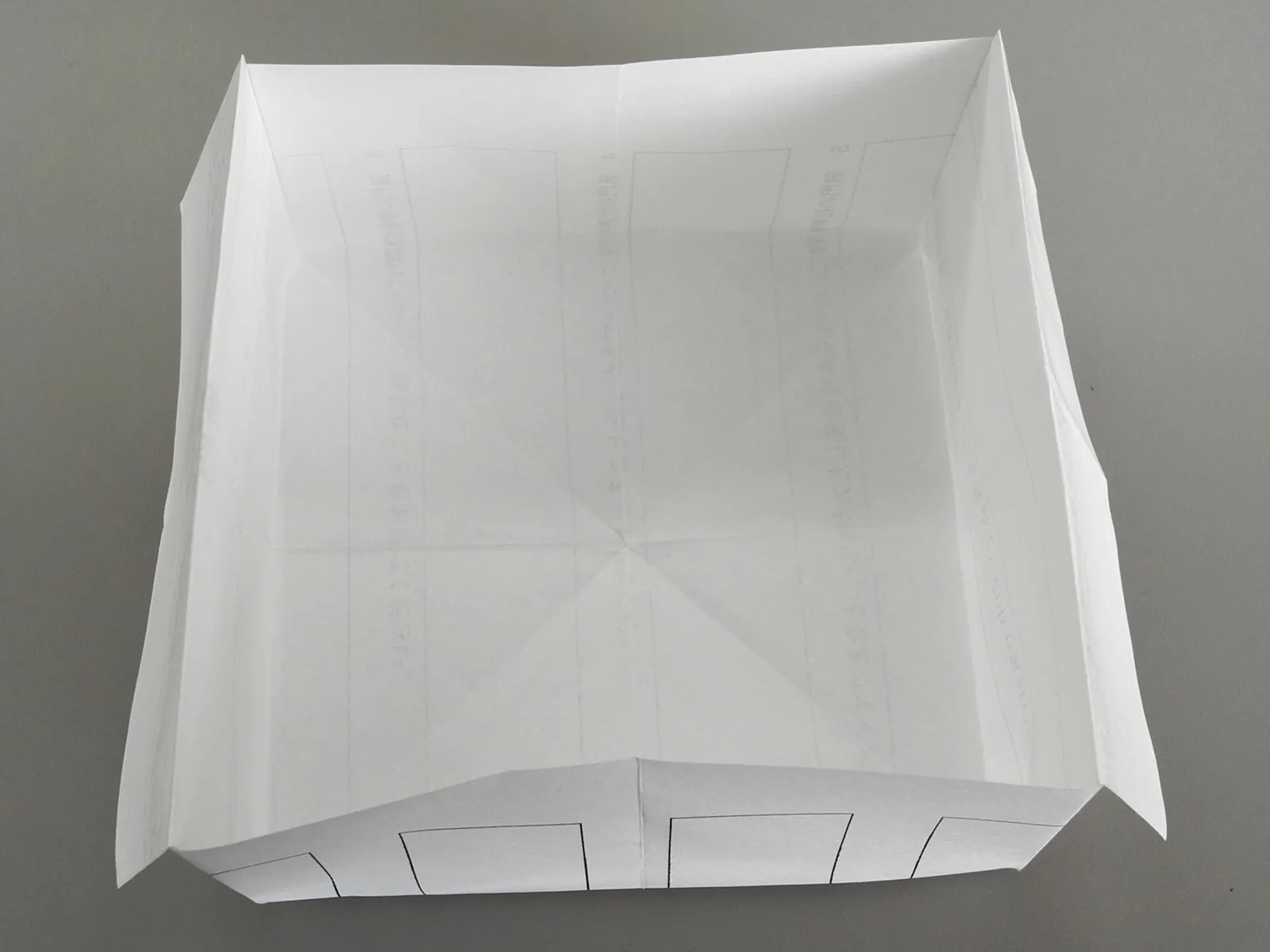
A masu box folded from a sheet of recycled office paper Fold all four corners to the center
Bring each corner exactly to the center point and crease firmly. This shape is called a blintz base. The neater the points meet, the squarer the box.
Crease the edges to the middle
Keeping the corners folded in, fold the top edge down to the horizontal center line and the bottom edge up to it, crease and unfold. Turn the paper 90 degrees and repeat. You now have a grid of creases.
Open two opposite corners
Unfold the top and bottom triangular flaps so they point outward. Leave the left and right flaps folded in.
Raise the long walls
Fold the left and right sides in along the existing creases and stand them up at 90 degrees. They form two walls of the box.
Form the third wall
Lift the top flap. Push the short creases at each end inward so the paper folds into a corner and the end wall stands up, then fold the pointed flap down over the wall and into the bottom of the box. The point should reach the center.
Repeat and sharpen
Do the same with the bottom flap to finish the fourth wall. Run your fingernail along each top edge and pinch the corners so the box holds a crisp shape.
Fold the lid
Repeat steps 1 to 7 with the slightly larger square. The lid slides over the base; if it is too tight, try a square ⅜ in (1 cm) larger.
Paper choices and finishing touches
Thin, crisp paper folds most accurately. Standard origami paper and lightweight scrapbook paper both work; heavy cardstock cracks at the folds and makes the walls bulky. Wrapping paper is a good, cheap option for large boxes, though very glossy foil paper can show every mistaken crease.
For a coordinated look, fold the base in a solid color and the lid in a pattern. Line the base with a square of tissue or a mini cupcake liner before adding food. A strip of washi tape or narrow ribbon tied around the closed box keeps the lid on during travel.
What to put inside
- Earrings, a ring or a pendant on a small square of card
- Two or three wrapped truffles or homemade fudge
- A folded gift card or a handwritten note
- Seed packets, a small candle tin or a few tea bags (use a 12 in square)
Nested boxes in three sizes make a fun reveal. For other ways to wrap small gifts without tape, see how to wrap gifts without tape and furoshiki cloth wrapping.
Folding with kids
Children around 7 and up can usually fold a masu box with help, especially with 8 in or larger paper, which is easier for small hands. Folding is safe, but an adult should handle any craft knife or rotary trimmer used to cut squares. If the box will hold candy for very young children, remember that small wrapped sweets are a choking risk under age 4.
Frequently asked questions
How do I make the lid fit?
Fold the lid from a square about ¼ in (6 mm) larger than the base. If your paper is thick, go up to ⅜ in (1 cm).
Do I need glue?
No. The flaps tucked into the bottom lock the walls in place. A dot of glue under each flap helps only if the box will carry heavier items.
Why is my box lopsided?
Usually the starting paper was not perfectly square or the corners did not meet exactly at the center in step 2. Recut the square and refold slowly.
Can I fold a rectangular box?
Yes, there are rectangular variations, but master the square masu box first; its creases are the basis for most box designs.
Find more folded and cut-paper projects in our paper crafts section and the wider gift wrapping guides.
Sources
- Wikipedia — Masu (measurement). en.wikipedia.org
Image credits. Top image: OrigamiBoxes 5149 by Changku88, CC BY-SA 4.0, via Wikimedia Commons · In-article image: White origami box by Douglas P Perkins, CC BY-SA 3.0, via Wikimedia Commons
Spotted something out of date or a gift that's no longer available? Tell our editors — we review every correction.