How to make paper flowers for a bouquet that lasts
Tissue paper carnations take minutes and crepe paper roses look real. Here is how to make both, size them for a bouquet and wrap them as a gift.
Quick answer
The easiest paper flower for a gift is the tissue paper carnation: stack six to eight rectangles of tissue about 5 × 7 inches (13 × 18 cm), accordion-fold them into ¾-inch pleats, twist a stem wire around the middle, trim the ends round or pointed, and gently pull each layer up toward the center. A bunch of five to seven takes about an hour and never wilts. Crepe paper roses are the next step up.
- Time 5 – 10 minutes per tissue flower; 20 – 30 per crepe rose
- Difficulty Beginner (tissue) to easy-intermediate (crepe)
- Cost $10 – $25 for a bouquet
- Makes A bouquet of 5 – 9 flowers, about 3 – 4 in (8 – 10 cm) across
Paper flowers are one of the most forgiving crafts there is. The folds do not need to be perfect, because fluffing the petals hides small mistakes, and a single pack of tissue paper makes a whole bouquet. They also last: a paper bouquet for a first (paper) anniversary, a teacher or a friend who cannot keep plants alive stays bright for years if it is kept out of strong sun and humidity.
Materials
- Tissue paper in two or three colors (a standard 20 × 30 in / 50 × 75 cm pack is plenty)
- Paper-covered floral stem wire, 18 to 22 gauge, or green pipe cleaners
- Green floral tape
- Sharp scissors and a ruler
- Wire cutters (do not use your fabric or paper scissors on wire)
- For crepe roses: heavy crepe paper (about 180 g), a pencil or skewer for curling, and tacky glue or a low-temperature glue gun
- Optional: green cardstock or crepe for leaves, a ribbon, kraft paper or a small vase for presenting
How to make tissue paper carnations
Cut the tissue
Cut rectangles of about 5 × 7 in (13 × 18 cm). Stack six to eight layers for one flower. For a two-tone bloom, put two sheets of an accent color on top of the stack.
Accordion-fold the stack
Starting at a short edge, fold the whole stack back and forth in pleats about ¾ in (2 cm) wide, pressing each fold flat with your fingernail. You will end up with a narrow strip about 5 in long.
Shape the petal ends
Trim both ends of the folded strip: cut them into a half-circle for soft, rounded petals, or into a point or a zigzag for a carnation look. Small snips into the ends give a frilly edge.
Add the stem
Pinch the strip in the exact middle and wrap one end of a stem wire tightly around it two or three times. Twist the wire on itself so it cannot slip. Bend the sharp cut end inward so no point sticks out.
Fan out the pleats
Open the folded strip into a bow-tie shape so both halves fan out evenly.
Separate the layers
Holding the center, gently pull the top sheet up toward the middle, then the next, working around one side and then the other. Go slowly, since tissue tears easily near the wire. Stop when the flower looks full and round.
Wrap the stem and add leaves
Starting just under the bloom, stretch floral tape slightly to activate its tackiness and wind it down the wire at an angle. Tuck in a leaf cut from green paper halfway down and tape over its base.
Tip: Make flowers in three sizes for a natural bouquet: cut rectangles of 4 × 6 in, 5 × 7 in and 6 × 9 in (10 × 15, 13 × 18 and 15 × 23 cm).
Next step: a simple crepe paper rose
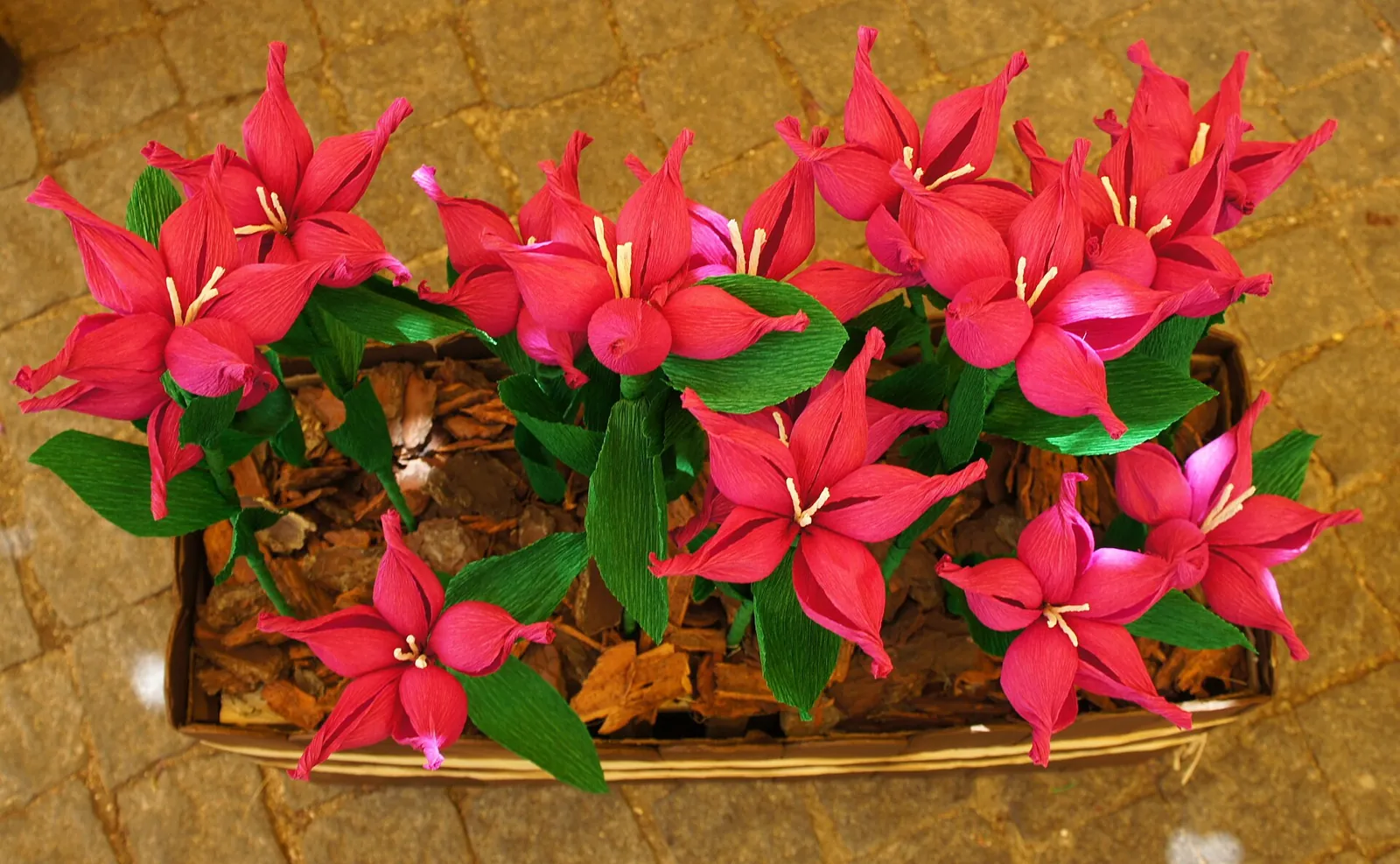
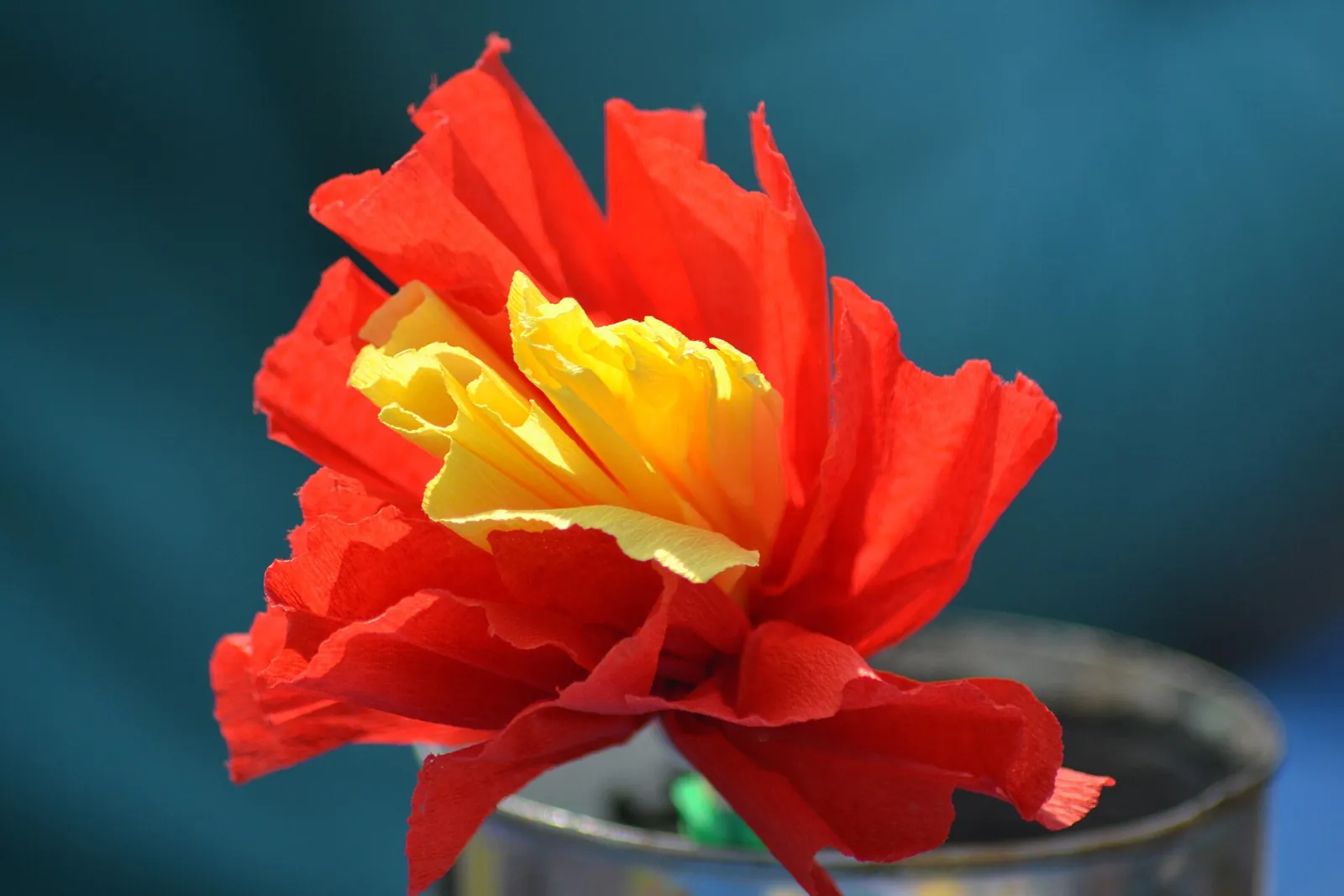
Crepe paper stretches, which lets you cup petals the way real ones curve. Cut a strip of crepe about 2½ in (6 cm) tall and 20 in (50 cm) long with the grain running vertically, so the stretch goes up and down the petals. Cut a row of rounded petal shapes along one long edge without cutting all the way through. Curl the top of each petal outward over a pencil, then gently stretch the center of each petal with your thumbs to make it cup. Glue the base of the strip to the top of a wire, and roll the strip around it, pinching and gluing at the base every few turns, keeping the inner petals tighter and the outer ones looser. Wrap the base and stem with floral tape.
Safety notes
- Cut wire with wire cutters, point the cut end away from your face, and fold back or tape any sharp tips, especially in bouquets for children.
- Hot glue causes burns. Use a low-temperature glue gun or tacky glue, keep a bowl of cold water nearby, and supervise children closely.
- Tissue and crepe paper are flammable: keep paper flowers well away from candles, fireplaces and heaters.
- Some tissue and crepe dyes bleed when wet. Keep the flowers dry and off light-colored fabric in humid weather.
How to present a paper bouquet
Gather five to nine stems, vary the heights by an inch or two, and bind them with floral tape. Wrap the bundle in a cone of kraft paper or a sheet of patterned paper and tie it with ribbon, or stand the stems in a small jar weighted with dried beans. Add a tag with a line about why you chose the colors; our guide to flower meanings can help, and homemade gift tags finish the look. For more ideas, browse our paper crafts.
Frequently asked questions
What paper is best for paper flowers?
Tissue paper is cheapest and easiest for fluffy blooms. Heavy crepe paper gives the most realistic petals because it stretches and holds a curve. Cardstock works for flat, layered flowers glued to cards or walls.
How long do paper flowers last?
Indoors, away from direct sunlight and damp, they can last for years. Sun fades tissue and crepe dyes, and moisture makes petals droop.
Can kids make tissue paper flowers?
Yes. Children can fold and fluff the petals; use pipe cleaners instead of wire stems for young kids, and let an adult do any cutting of wire.
How do I make them smell nice?
Skip adding oils, which can stain paper. Tuck a small sachet of dried lavender into the gift wrap instead.
Image credits. Top image: Crepe paper flowers (20428764251) by Chris, CC BY-SA 2.0, via Wikimedia Commons · In-article image: Papierblume by Norbert Höldin, CC0 1.0, via Wikimedia Commons
Spotted something out of date or a gift that's no longer available? Tell our editors — we review every correction.