New Year's lucky charms and what they mean
Marzipan pigs, chimney sweeps, clovers and lucky pennies: where Germany's New Year's lucky charms come from, plus luck traditions worldwide and gift ideas for each.
Quick answer
The best-known New Year's lucky charms come from Germany, where people give each other small Glücksbringer on Silvester (New Year's Eve) and New Year's Day: a marzipan pig, a four-leaf clover, a horseshoe, a chimney sweep, a fly agaric mushroom, a ladybug or a lucky penny. Elsewhere, luck is often eaten instead: grapes at midnight in Spain, lentils in Italy, mandarins at Lunar New Year. Any of these makes a small, cheerful good luck gift, bought or homemade.
- When New Year's Eve and New Year's Day
- Typical budget $2 – $25 per charm
- Strongest tradition Germany and Austria (Glücksbringer)
- Lead pouring Lead sets can no longer be sold in the EU (since 2018); wax is the usual substitute
Why people give lucky charms at New Year
A lucky charm turns a spoken "Happy New Year" into something you can hold. Nobody expects it to be expensive, so it is easy to give to a neighbor, a whole office or every guest at a party. The meanings below are folklore, and explanations vary from source to source; a line on a small card about what your charm stands for makes the gift twice as nice.
German New Year traditions: lucky charms (Glücksbringer) and what they mean
In German-speaking countries, shops fill up with lucky symbols in late December, and people hand them out at Silvester parties or tuck them next to dinner plates. These are the classics; for wider customs, see our German gift etiquette guide.
Glücksschwein (lucky pig)
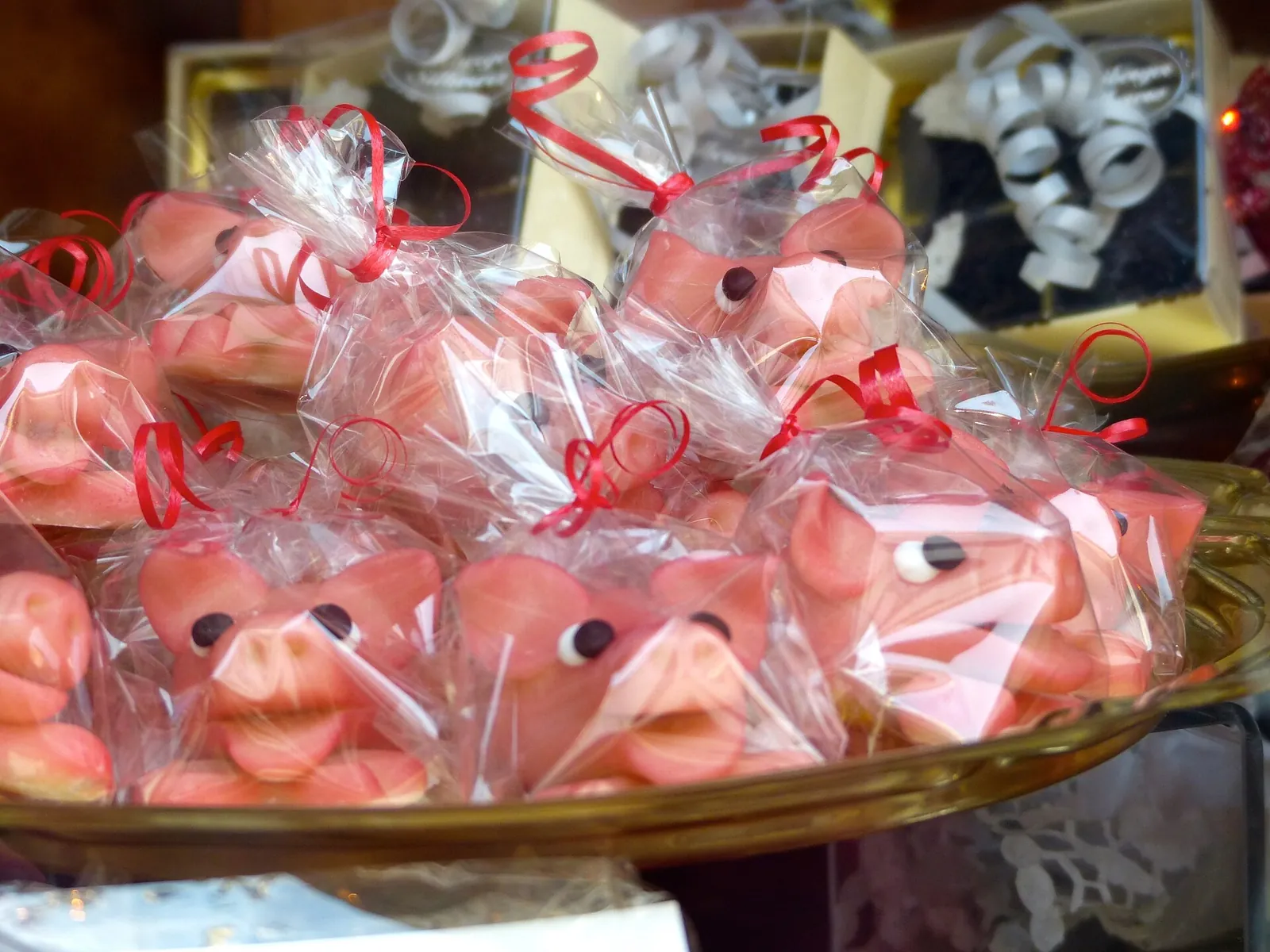
The pig is probably the most popular German New Year's charm, usually as a pink marzipan pig. One common explanation is that pigs became a positive symbol long ago because of their fertility and the abundance they stood for. Another links the German saying Schwein gehabt ("had a pig," meaning "got lucky") to medieval tournaments, where the worst rider is said to have received a pig as a consolation prize. Either way, the pig means prosperity and plain good fortune.
Kleeblatt (four-leaf clover)
Four-leaf clovers are lucky largely because they are rare. Explanations range from the Celts, who are said to have believed clover protected against evil magic, to a legend that Eve took a four-leaf clover with her out of Paradise. In the Middle Ages, travelers reportedly had four-leaf clovers sewn into their clothes. A strict superstition holds that the clover only brings luck if you find it by chance; the potted "lucky clover" sold each December is more a cheerful gift than a real charm.
Hufeisen (horseshoe)
Horseshoes are believed to ward off bad luck and catch the good kind. In German folk belief a horseshoe should be hung with the open end up, so the luck cannot fall out, and some say it only works if it was found rather than bought. The origin of the belief is not clearly documented.
Schornsteinfeger (chimney sweep)
The chimney sweep's luck has a practical root. When houses were heated and cooking was done over open fires, a blocked chimney could set a home, or a whole street, on fire. The sweep who cleaned it kept the household safe and warm. To this day, meeting a sweep is considered lucky, and even a smudge of soot on the face is said to bring good fortune. As a gift, he appears as a figurine or chocolate, often holding a ladder, a pig or a clover.
Fliegenpilz (fly agaric mushroom)
The red mushroom with white spots is a surprising symbol, because the real fly agaric is poisonous. Its history as a charm is not well documented. One legend connects it to the Norse god Odin, saying the mushroom grew where foam from his horse fell during his midwinter ride. Give it as a marzipan, felt or ceramic version, never a real mushroom.
Marienkäfer (ladybug)
The German name means "Mary's beetle," linking the insect to the Virgin Mary. In older folk belief, any ladybug brought luck, especially if you caught it with your left hand and kept it in your pocket. Chocolate ladybugs wrapped in red foil are a classic New Year's treat.
Glückspfennig (lucky penny)
The lucky penny goes back to the first coin a godparent gives a baby, which was carefully kept. The belief survived the switch to the euro, although the name "Glückscent" never really caught on. A shiny copper coin is often added to other charms, glued to a card or pressed into a marzipan pig.
Tip: A mixed set works best as a gift. A pig, a clover, a sweep and a coin in a small bag or on a card covers health, prosperity and safety in one go.
Bleigießen: why lead pouring became wax pouring
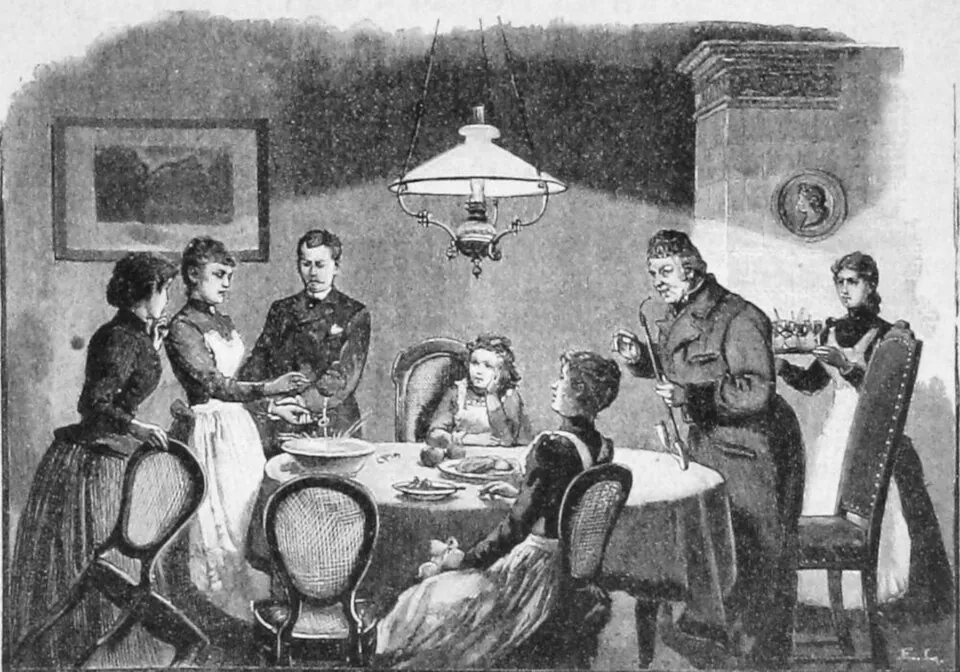
For generations, German families melted small lead shapes in a spoon over a candle on New Year's Eve, dropped the liquid metal into cold water and read the next year's fortune from the shape.
Since 2018, lead-pouring sets can no longer be sold in the EU, because EU chemicals rules now limit lead in consumer products far below what these sets contained. Consumer testers note that melting lead releases fumes, the figures leave lead on hands, and molten metal splashes cause bad burns. Germany's Federal Institute for Risk Assessment (BfR) says no safe threshold has been established for lead's effects on the nervous system.
The custom itself lives on with safer materials:
- Wax pouring (Wachsgießen): melt leftover candle wax in an old spoon and drop it into cold water. Shapes are less crisp, but it is the most common replacement, and ready-made wax sets are sold each December.
- Tin: pure tin is lead-free, but casting tin can contain lead, so check the label.
- Dough: drop small blobs of dough into hot oil and eat the fortune afterwards. An adult should handle the oil.
Any pouring game involves heat: keep children away from the flame, hot wax and oil, and work over a tray.
Lucky New Year traditions around the world
Elsewhere, New Year's luck is more often eaten or worn than given as a charm:
- Spain: twelve grapes, one on each stroke of midnight, for a lucky year. Many Spaniards also wear red underwear.
- Italy: lentils with cotechino sausage at midnight, because the round lentils resemble coins, and red underwear for good fortune.
- Greece and Cyprus: a coin is baked into the vasilopita cake, and whoever finds it in their slice is lucky for the year. Some smash a pomegranate on the doorstep for health and happiness.
- Lunar New Year: mandarins and oranges are given because their names sound like words for luck and success, ideally in pairs and with leaves attached. See our Lunar New Year gift ideas for more.
Lucky symbols do not always travel well; see our guide to lucky colors and numbers in gift giving before giving across cultures.
Good luck gifts for New Year, charm by charm
Prices are typical US ranges; most are easy to make, too (see our DIY New Year gifts).
| Charm | Buy it as | Make it as |
|---|---|---|
| Lucky pig | Marzipan pig, ceramic piggy bank ($3 – $20) | Homemade marzipan pigs, pig-shaped cookies |
| Four-leaf clover | Potted lucky clover, clover pendant ($5 – $40) | Pressed-clover card, green felt clover |
| Horseshoe | Small brass or iron horseshoe for the door ($8 – $25) | Horseshoe cookies, painted wooden horseshoe |
| Chimney sweep | Chocolate or wooden sweep figure ($3 – $15) | Clothespin sweep with a pipe-cleaner ladder |
| Fly agaric | Felt or glass mushroom ornament ($4 – $15) | Painted wooden-bead mushrooms, marzipan mushrooms |
| Ladybug | Foil-wrapped chocolate ladybugs ($3 – $10) | Painted-stone ladybug paperweight |
| Lucky penny | Coin keychain, coin in a card ($2 – $10) | Shiny coin glued into a handwritten card |
A potted lucky clover is usually an Oxalis plant rather than true clover. It is mildly toxic if eaten, so give it to households without pets that nibble plants, and tell the recipient it likes bright light and a cool room. For more ideas that are not charms, see our main New Year gift ideas.
How to give them
- Hand charms out at midnight or with breakfast on New Year's Day.
- Add a one-line note: "A pig for prosperity in the new year."
- Don't give real mushrooms or anything that looks edible to small children unless it is food.
- Don't assume every culture shares German symbols; a pig, for example, may be unwelcome in some Muslim or Jewish households.
Frequently asked questions
What is the most common German New Year's lucky charm?
The lucky pig, usually made of marzipan, is the best known, closely followed by the chimney sweep and the four-leaf clover. Many charms show several symbols together.
Is Bleigießen illegal in Germany?
Lead-pouring sets can no longer be sold in the EU since 2018 because of limits on lead in consumer products. Most people now use wax, which works the same way and is far safer.
Why is a poisonous mushroom a lucky charm?
Nobody knows for certain; folk legends link it to midwinter. As a charm it is always a decoration or a sweet, never the real mushroom.
Sources
- t-online — Silvester und Neujahr: Warum bringen Schornsteinfeger und Co. Glück? t-online.de
- Planet Wissen (WDR) — Der Weg zum Glück: Glücksbringer. planet-wissen.de
- Stiftung Warentest — Bleigießen: Besser bleifrei ins neue Jahr (2021). test.de
- NC State Extension Plant Toolbox — Oxalis (good luck plant). plants.ces.ncsu.edu
- Euronews — How does Europe ring in the New Year? (2024); History.com — Symbolic foods of Chinese New Year. euronews.com, history.com
Image credits. Top image: Marzipan Glückschweine by Geolina163, CC BY-SA 4.0, via Wikimedia Commons · In-article image: Die Gartenlaube (1890) b 827 2 by various, Public domain, via Wikimedia Commons
Spotted something out of date or a gift that's no longer available? Tell our editors — we review every correction.