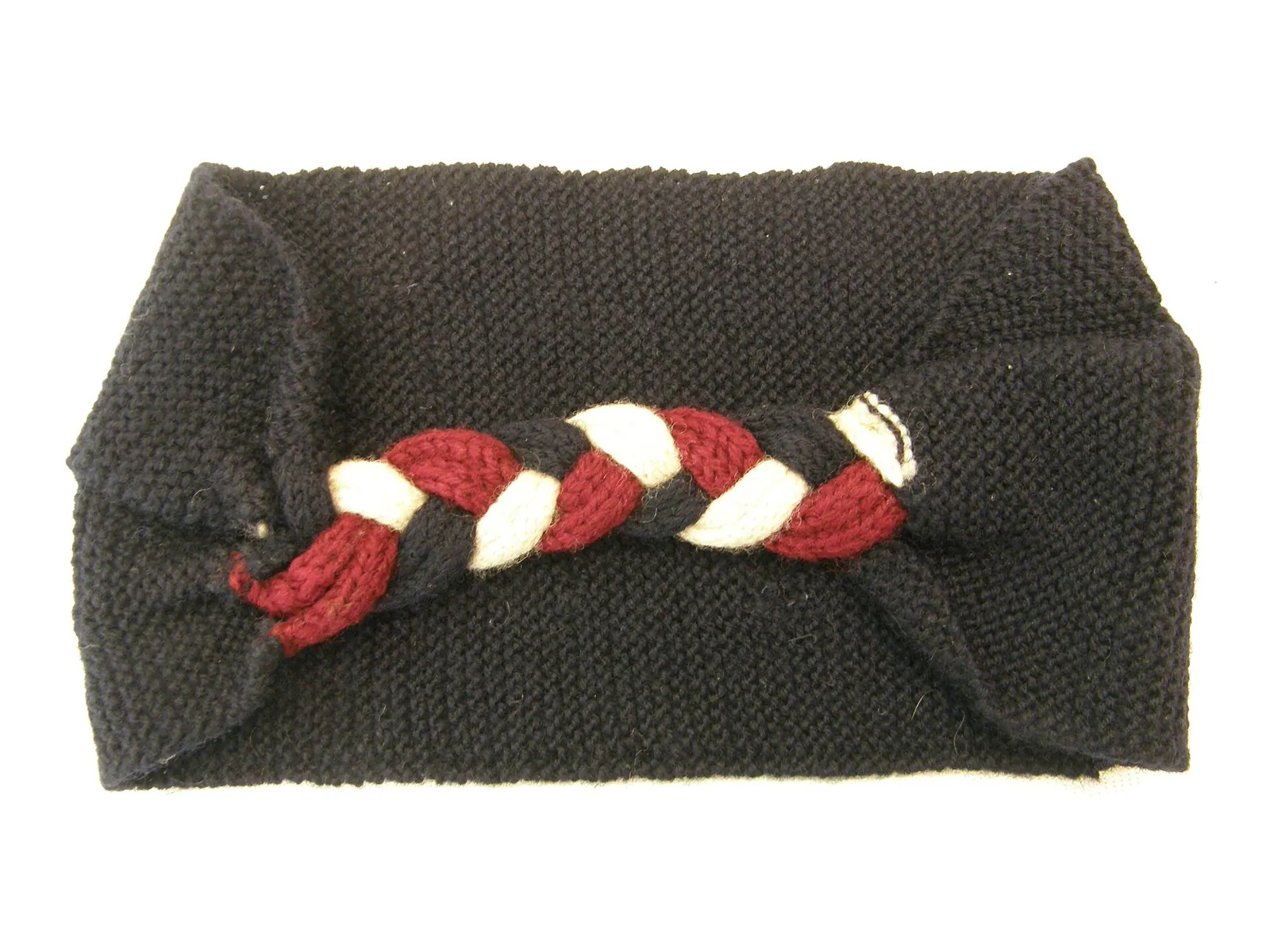
Knitted headband ear warmer: an easy seed-stitch pattern
Fifteen stitches of seed stitch in bulky yarn, sewn into a ring or a twist: a quick ear warmer sized from a standard head chart.
Quick answer
Cast on 15 stitches of bulky (category 5) yarn on US 10½ (6.5 mm) needles and work seed stitch (*knit 1, purl 1*, end knit 1) on every row until the band is about 2 – 3 in shorter than the wearer's head: roughly 18½, 19½ or 20½ in for small, medium and large. Bind off, then sew the short ends together, either straight or folded into a twist. It takes an evening and about 60 – 80 yd of yarn.
- Time 2 – 4 hours (estimate)
- Difficulty Beginner: knit, purl and a simple seam
- Cost $6 – $20 for one skein of bulky yarn
- Makes One ear-warmer headband, about 4¼ in (11 cm) wide
A knitted headband, or ear warmer, keeps ears warm without flattening a hairstyle, which is why it makes such a welcome gift for runners, dog walkers, commuters and anyone with a ponytail. It is also a perfect first "real" pattern: a single rectangle in a textured stitch, sewn into a ring. Finish it with a twist at the front and it looks like something from a boutique.
Sizing the headband
The Craft Yarn Council's head circumference chart gives typical ranges of about 20 – 22 in for tweens, 21 – 23 in for adult women and 22 – 24 in for adult men. Knitted headwear is made a little smaller than the head (negative ease) so it stays put; Knit Picks recommends about 2 in of negative ease for hats. Because this band is knitted lengthwise and seed stitch stretches less than ribbing, aim for a band 2 to 3 in shorter than the head, then test it.
| Size | Head circumference | Band length before seaming |
|---|---|---|
| S (tween, teen) | 20 – 22 in (51 – 56 cm) | About 18½ in (47 cm) |
| M (most women) | 21 – 23 in (53 – 58.5 cm) | About 19½ in (49.5 cm) |
| L (most men) | 22 – 24 in (56 – 61 cm) | About 20½ in (52 cm) |
If you can measure the recipient's head discreetly (or borrow a hat that fits them and measure its unstretched circumference), use that number minus 2 to 3 in. The twisted finish uses about 1 in of length, so add 1 in if you plan to twist.
Materials
- Bulky (category 5) yarn: about 60 – 80 yd (55 – 73 m), so one skein of 100 yd or more is plenty. Soft wool, wool blend or acrylic
- US 10½ (6.5 mm) straight needles
- Tapestry (yarn) needle with a large eye
- Scissors, tape measure, two clips or locking stitch markers
The Craft Yarn Council lists needles of US 9 – 11 (5.5 – 8 mm) and a gauge of 12 – 15 stitches per 4 in for category 5 yarn. Aim for about 14 stitches per 4 in; at that gauge 15 seed stitches make a band a little over 4 in wide. For a wider 5 in band, cast on 17 stitches; keep any odd number. The yardage is an estimate scaled from typical hat yardages, so a full skein gives you a comfortable margin.
How to knit the headband
Cast on 15 stitches
Use the long-tail cast-on, leaving a 12 in (30 cm) tail; you can use it later to sew the seam. An odd number of stitches is what makes seed stitch work with a single repeat.
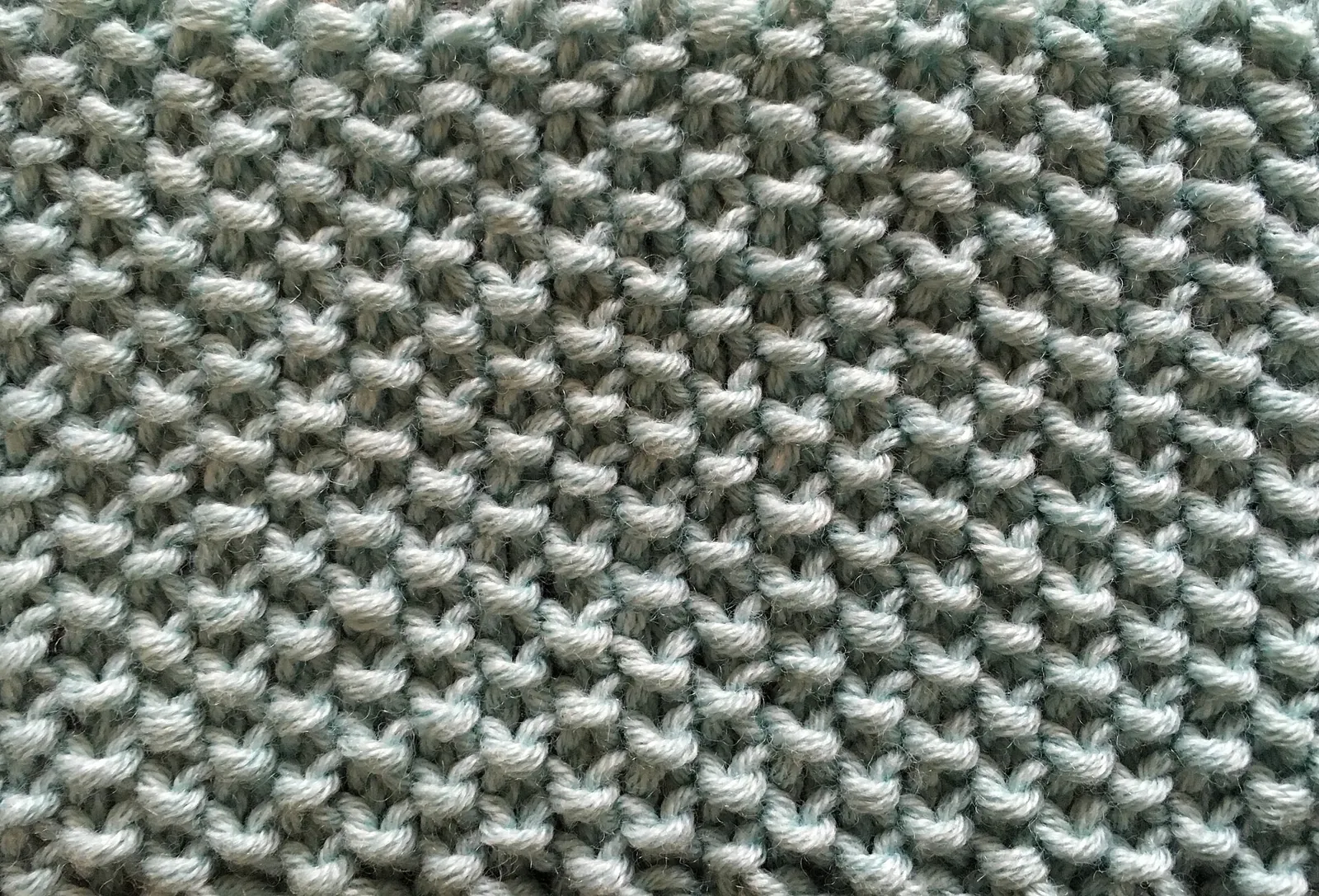
A swatch in moss stitch, the UK name for seed stitch Work the seed stitch row
Every row: *knit 1, purl 1*, repeat to the last stitch, knit 1. With 15 stitches that is seven knit-purl pairs plus one knit. Because the count is odd, each row begins and ends with a knit, and each stitch is worked opposite to how it appears. Knit the stitches that look like purl bumps and purl the smooth "V" stitches; that alternation creates the pebbly texture.
Watch the yarn position
Bring the yarn to the front between the needles before each purl and to the back before each knit. Forgetting to move it adds a stray loop and an extra stitch. Count to 15 every few rows.
Knit to length and try it on
Continue until the band measures the length for your size. Wrap it around the head, or a similarly sized head, overlapping the ends: it should feel snug over the ears without pressing. Add or remove a few rows as needed.
Bind off in pattern
Work the first two stitches in seed stitch, lift the first over the second, and continue across, knitting the knits and purling the purls as you bind off. This keeps the edge as stretchy as the band. Leave a 12 in tail.
Sew the ends: straight seam
For a simple band, bring the short ends together with right sides facing and whipstitch or mattress stitch through the edge stitches. Turn right side out.
Or sew the ends: twisted front
Lay the band flat in a ring with the right side facing you and the two short ends meeting. Fold one end in half lengthwise so it becomes a narrow "U," and fold the other end in half the opposite way. Slide the two folded ends into each other so they interlock, clip them, and check the twist from the outside. Sew through all four layers, then turn so the seam sits on the inside.
Weave in ends and block
Weave tails along the seam on the inside and trim. Wet-block or steam according to the yarn label and let the band dry flat.
Tip: To keep the side edges neat, give the yarn a gentle tug after the first two stitches of every row.
Variations: knit every row instead of seed stitch for an even easier, very stretchy garter band; change color every 2 in for stripes; or make a matching set with our beginner knit beanie or a garter-stitch scarf in the same yarn.
Safety and care notes
- For young children, keep the band plain: no buttons, beads or pom-poms that could come off, and no ties.
- Follow the yarn label for washing. Regular wool should be hand washed in cool water and dried flat; superwash wool and most acrylics can go in the machine.
- Choose a soft, non-scratchy fiber for an item worn against the forehead, and ask about wool sensitivity if you are unsure.
How to package it as a gift
Fold the headband flat with the twist on top and wrap a paper band around it like a store label, with the fiber and care details written on the back. It fits easily into a card envelope or a stocking. For a runner, add a pair of gloves; for a skier, a lip balm and hand warmers. Browse our knit and crochet hub for more quick makes, or DIY Christmas gifts if you are knitting for the holidays.
Frequently asked questions
How long should a knitted headband be?
For most adults, about 18½ – 20½ in before seaming, which is 2 to 3 in shorter than the head. Use the Craft Yarn Council's head chart if you cannot measure the wearer.
How much yarn does a headband take?
This 15-stitch bulky band uses roughly 60 – 80 yd (an estimate). One standard skein of bulky yarn is plenty, often with enough left for a second band.
Why does seed stitch need an odd number of stitches?
With an odd count, every row starts and ends with knit 1 and you repeat the same row throughout. With an even count, you would need to alternate between two different rows.
Can I make it with worsted-weight yarn?
Yes. Use US 8 (5 mm) needles and cast on about 19 – 21 stitches (an odd number) for a similar width, then knit to the same length.
Sources
- Craft Yarn Council — Head Circumference Chart. craftyarncouncil.com
- Craft Yarn Council — Standard Yarn Weight System. craftyarncouncil.com
- Knit Picks — Hat Size Charts. knitpicks.com
Image credits. Top image: Headband (AM 1996.180.12-3) by Unknown author Unknown author, CC BY 4.0, via Wikimedia Commons · In-article image: Mosstickning by Hobbsansak, CC BY-SA 4.0, via Wikimedia Commons
Spotted something out of date or a gift that's no longer available? Tell our editors — we review every correction.