Crochet market bag: a stretchy mesh tote pattern
A round-bottomed cotton mesh bag that packs small and stretches to carry a full farmers market haul, with every round counted and US/UK terms explained.
Quick answer
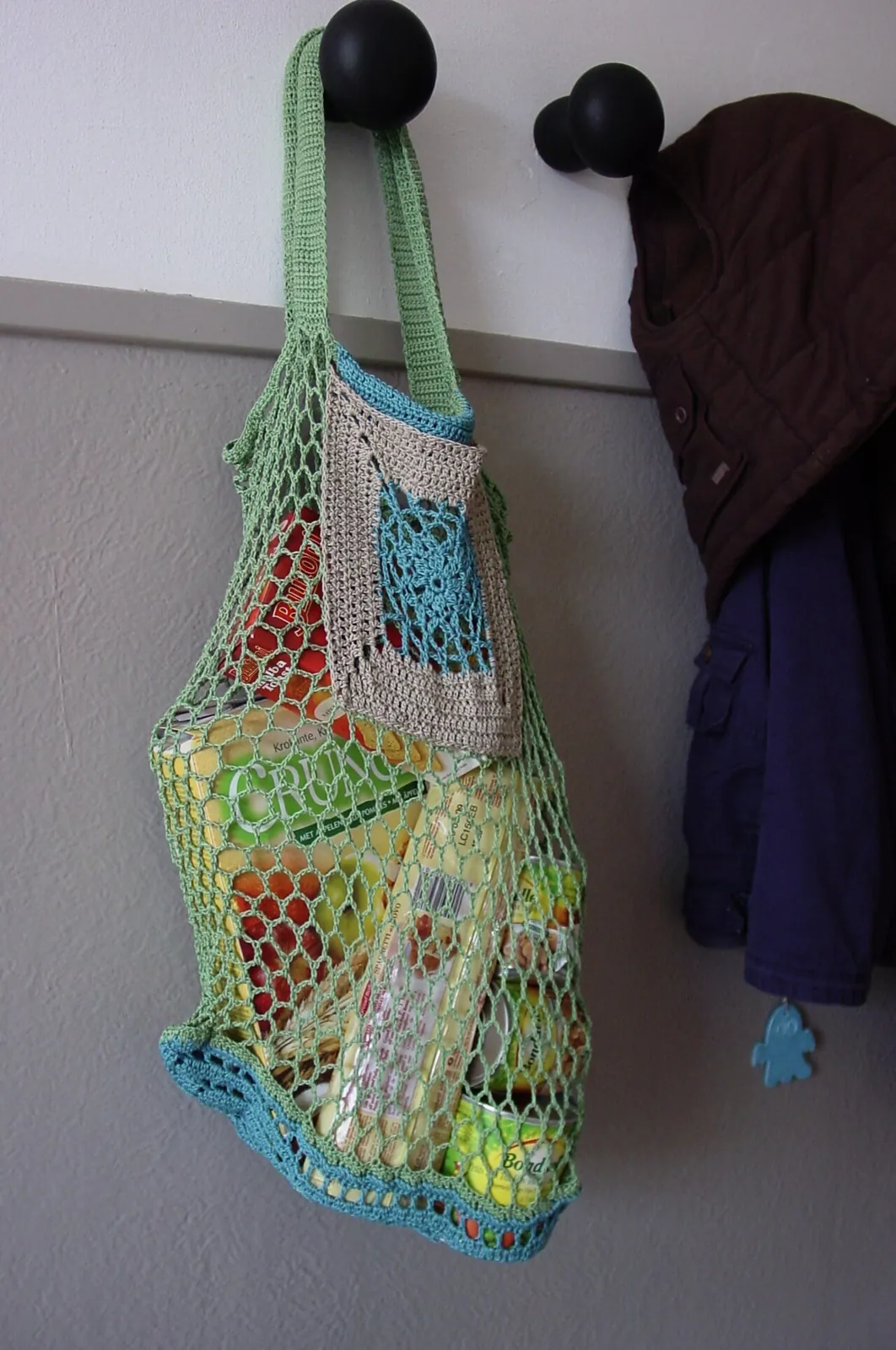
A crochet market bag is a round base of double crochet, a stretchy mesh body, and a firm single crochet rim with two handles. This pattern uses worsted-weight cotton and a 5 mm (US H-8) hook. You build a 96-stitch base, work 32 mesh spaces per round, and finish with a rim that makes room for two handle openings. It is a weekend project for a confident beginner and a useful, low-waste gift for anyone who shops at farmers markets.
- Time 6 – 10 hours
- Difficulty Advanced beginner (working in rounds, chain spaces)
- Cost About $12 – $25 in cotton yarn
- Makes One bag, base about 8 in (20 cm) across, body about 11 in (28 cm) tall before it stretches
A mesh market bag folds up to the size of a fist and then stretches around a melon, a few bunches of greens and a loaf of bread. That makes it a gift people actually reach for, and a natural fit for an eco-friendly gift or a zero-waste gift bundle. If you'd rather sew, a fabric tote bag is a sturdier everyday carry. Crochet mesh wins on weight and packability.
Terms, yarn and hook
This pattern uses US terms. In UK terms, single crochet (sc) is double crochet (dc), and US double crochet (dc) is a treble (tr). Chain (ch) and slip stitch (sl st, UK ss) are the same. Other abbreviations: st = stitch, sk = skip, sp = space, rnd = round.
- Worsted-weight cotton or cotton blend (Craft Yarn Council category 4, aran in the UK): about 250 to 350 yd (230 to 320 m). Three 120 yd balls is a safe amount; this is an estimate, since tension varies.
- A 5 mm (US H-8) crochet hook
- Stitch marker
- Tapestry needle
- Scissors
- Tape measure
Cotton is the practical choice because it is strong, washable and doesn't stretch out as much as some acrylics when loaded. A cotton-linen or cotton-recycled-fiber blend works too. The Craft Yarn Council's guideline hook range for category 4 is 5.5 to 6.5 mm (US I-9 to K-10½). This pattern goes slightly smaller to keep the base and rim firm. The mesh does the stretching.
How to crochet the bag
Rounds 1–4: start the base
The ch 2 at the start of each base round does not count as a stitch. Join every round with a sl st to the first dc.
Rnd 1: Magic ring, ch 2, 12 dc in the ring, pull closed, join. (12)
Rnd 2: Ch 2, 2 dc in each st around, join. (24)
Rnd 3: Ch 2, *dc in next st, 2 dc in next st* 12 times, join. (36)
Rnd 4: Ch 2, *dc in next 2 sts, 2 dc in next st* 12 times, join. (48)Rounds 5–8: finish the base
Keep adding one plain dc between increases each round. Each round has 12 repeats and gains 12 sts.
Rnd 5: *dc in next 3, 2 dc in next* (60) (12 × 5)
Rnd 6: *dc in next 4, 2 dc in next* (72) (12 × 6)
Rnd 7: *dc in next 5, 2 dc in next* (84) (12 × 7)
Rnd 8: *dc in next 6, 2 dc in next* (96) (12 × 8)
The base should lie flat and measure about 8 in (20 cm). If it ruffles, your tension is loose; try a 4.5 mm hook. If it cups, check for a missed increase.Round 9: set up the mesh
Ch 5 (counts as 1 dc plus ch 2), sk next 2 sts, *dc in next st, ch 2, sk next 2 sts*; repeat from * around and join with a sl st to the 3rd ch of the starting ch-5. (32 dc and 32 ch-2 spaces) Check: each repeat uses 3 base stitches, and 96 ÷ 3 = 32. Your last dc lands in stitch 94, and the final ch 2 skips stitches 95 and 96.
Rounds 10–28: grow the mesh
Ch 5 (counts as dc plus ch 2), *dc in next dc, ch 2*; repeat from * around and join to the 3rd ch of the ch-5. (32 spaces) Work 19 rounds like this, for 20 mesh rounds in all, or until the mesh measures about 11 in (28 cm) from the base when you hold it up without pulling. Count your spaces every few rounds. A missing space usually means you skipped the dc hidden behind the starting chain.
Rounds 29–31: firm rim
Rnd 29: Ch 1, sc in the same st as the join, 2 sc in the next ch-2 space, *sc in next dc, 2 sc in next ch-2 space*; repeat from * around and join to the first sc. (96) Check: 32 repeats × 3 = 96, matching the base.
Rnds 30–31: Ch 1, sc in each st around, join. (96)Round 32: handle openings
Ch 1, sc in next 9 sts, ch 60, sk next 30 sts, sc in next 18 sts, ch 60, sk next 30 sts, sc in last 9 sts, join. Check: 9 + 30 + 18 + 30 + 9 = 96. The handles sit on opposite sides, and the join falls in the middle of one side panel. Make sure the chains aren't twisted before you continue.
Rounds 33–34: build the handles
Rnd 33: Ch 1, sc in each sc and in each ch around (work into the back bump of each chain for a neat edge), join. (156) Check: 9 + 60 + 18 + 60 + 9 = 156.
Rnd 34: Ch 1, sc in each st around, join. (156) Fasten off.
For shoulder-length handles, chain 90 instead of 60 in round 32. Rounds 33 and 34 then have 216 sts (9 + 90 + 18 + 90 + 9).Finish
Weave in all ends securely, changing direction at least once. Wear and weight will work loose ends free. Optional: add a second round of sl st around each handle opening for extra firmness. Turn the bag right side out, since the base usually looks neater from the outside.
Tip: Before you commit to 20 mesh rounds, load the bag after about 10 with a couple of cans or a bag of apples and see how far it stretches. Cotton mesh can grow noticeably under weight, so you may want fewer rounds than you think.
Safety and care
- Don't overload crochet handles. Heavy glass bottles and big bags of potatoes strain the rim. Spread weight across both handles and carry heavier loads from the base.
- Wash according to the yarn label. Many cottons can be machine-washed but shrink a little and dry slowly, so lay the bag flat or hang it to dry fully before folding it away. Damp cotton left folded can mildew.
- Rinse it after carrying unwashed produce or anything that leaks.
Gift it with a purpose
Fold the bag into a neat square and tie it with a strip of fabric. Or fill it: a few seasonal fruits, a jar of local honey, a bar of handmade soap and a handwritten note on the farmers market's opening days. Add a care tag with the fiber content and washing instructions. Pair it with a set of crocheted dishcloths in the same cotton for a matching kitchen bundle. More projects are in our knit and crochet section.
Frequently asked questions
What yarn is best for a crochet market bag?
Worsted-weight cotton or a cotton blend. It is strong, washable and holds its shape better than very stretchy fibers. Avoid fuzzy or very soft yarns that pill and snag on produce.
How much yarn do I need for a crochet mesh bag?
For this size, roughly 250 to 350 yd of worsted cotton, depending on tension and handle length. Buy an extra ball from the same dye lot if you plan longer handles.
Why does my mesh bag twist or spiral?
Usually the starting chain of each round is drifting, or you are working into the wrong stitch after the join. Make sure each round's first dc goes into the dc directly above the join, and count 32 spaces.
Can I make it in UK terms?
Yes. Read US single crochet as UK double crochet and US double crochet as UK treble. Chains, slip stitches and stitch counts don't change.
Sources
- Craft Yarn Council — Standard Yarn Weight System. craftyarncouncil.com
- Craft Yarn Council — Crochet Abbreviations (US and UK terms). craftyarncouncil.com
- Craft Yarn Council — Hooks and Needles size chart. craftyarncouncil.com
- B.hooked Crochet — How to Crochet a Flat Circle (increase chart). bhookedcrochet.com
Image credits. Top image: Blue-green meshwork bag (1091182610) by Breibeest from Nederland, CC BY 2.0, via Wikimedia Commons
Spotted something out of date or a gift that's no longer available? Tell our editors — we review every correction.