How to sew reusable fabric gift bags with French seams
One rectangle, two French seams and a drawstring: a neat, washable gift bag in under an hour, with cut sizes from jewelry pouch to bottle bag.
Quick answer
Cut one rectangle of prewashed cotton, fold it in half at the bottom, sew the two sides with French seams (1/4 in, then 1/4 in, for a 1/2 in / 1.3 cm total seam allowance), stop the side seams 2 1/4 in below the top edge, hem those short openings, then fold the top down 1/4 in and 1 in to make a channel for a ribbon or cord. A medium bag is cut 9 × 20 1/2 in and finishes at 8 × 9 in. Every raw edge ends up enclosed, so the bag survives years of reuse and washing.
- Time 30 – 45 minutes per bag (faster in batches)
- Difficulty Beginner: straight seams only
- Cost $2 – $6 per bag in quilting cotton and ribbon
- Makes One drawstring bag; sizes from 6 × 6 in to 12 × 14 in
A fabric gift bag is wrapping that becomes part of the present. It hides lumpy shapes, and the recipient can reuse it or keep it for storing shoes, chargers or toys. Because there is no bottom seam and the sides use French seams, the inside looks as tidy as the outside, which is what makes a homemade bag feel like a gift rather than a stopgap.
Materials and cut sizes
- Woven cotton: quilting cotton, cotton-linen blend, lightweight canvas or a clean secondhand shirt or pillowcase
- Drawstring: 1/4 in cord, 3/8 in ribbon, twill tape or bias tape (lengths in the table)
- Matching all-purpose thread
- Fabric scissors or rotary cutter, mat and ruler
- Pins or clips, fabric marker or chalk, and a large safety pin or bodkin for threading
- Iron and ironing board; sewing machine with a universal needle
| Bag | Cut (width × length) | Finished (approx.) | Drawstring |
|---|---|---|---|
| Small (jewelry, candles, socks) | 7 × 14 1/2 in (17.8 × 36.8 cm) | 6 × 6 in (15 × 15 cm) | 24 in (61 cm) |
| Medium (books, mugs, soap sets) | 9 × 20 1/2 in (22.9 × 52 cm) | 8 × 9 in (20 × 23 cm) | 28 in (71 cm) |
| Bottle | 7 × 32 1/2 in (17.8 × 82.6 cm) | 6 × 15 in (15 × 38 cm) | 24 in (61 cm) |
| Large (sweaters, board games) | 13 × 30 1/2 in (33 × 77.5 cm) | 12 × 14 in (30 × 36 cm) | 36 in (91 cm) |
How the numbers work: the width is the finished width plus 1 in (two 1/2 in side seams). The length is twice the finished height plus 2 1/2 in, because the top channel uses 1 1/4 in on each half (a 1/4 in turn plus a 1 in fold). The drawstring is twice the finished width plus about 12 in for tying. To make any other size, use the same three rules. Half a yard of 44 in wide cotton, measured after washing, is enough for two medium and two small bags if you lay the long edges of the pieces along the length of the fabric.
Tip: For a bottle bag, measure around the widest part of the bottle and halve it; the finished flat width should be at least that number plus 1 in so the bottle slides in easily. Six inches suits many standard wine bottles, but check yours.
How to sew a drawstring gift bag
Prewash, press and cut
Wash and dry the fabric the way the finished bag will be washed, since cotton and linen can shrink. Press it flat, then cut your rectangle on the straight grain. A directional print should run up from the center fold on both halves, so cut two pieces with a 1/2 in bottom seam instead if the pattern would end up upside down on one side (add 1 in to the cut length).
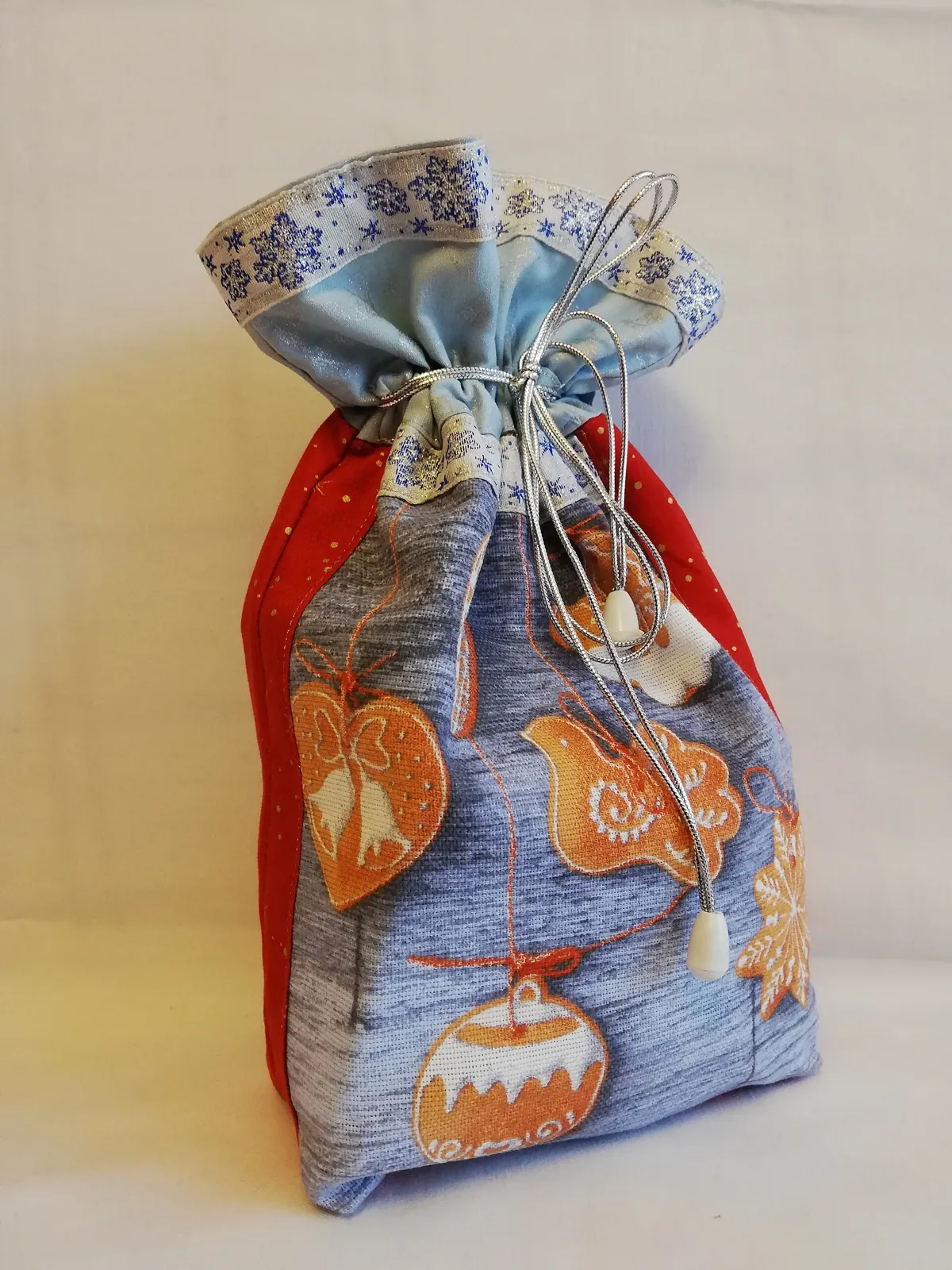
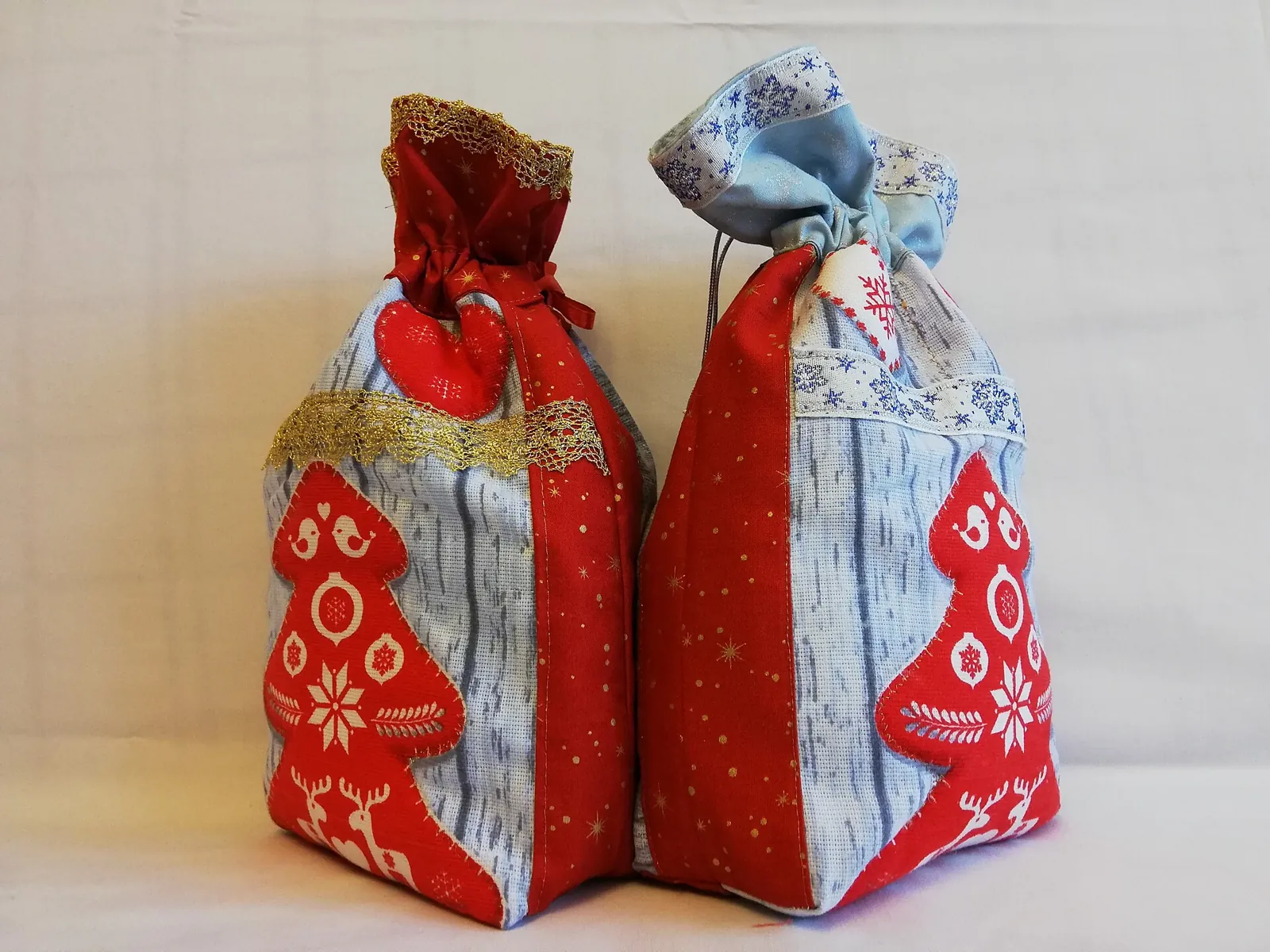
A drawstring gift bag sewn from patchwork panels for the New Year Mark where the side seams stop
Fold the rectangle in half crosswise, wrong sides together, so the short edges meet at the top. On both long sides, make a mark 2 1/4 in (5.7 cm) down from the top raw edge. The seams stop here, which leaves an opening for the drawstring to come out.
Sew the first pass of the French seams
Still wrong sides together, stitch each side from the bottom fold up to the mark with a straight stitch and a 1/4 in seam allowance. Backstitch at both ends. Trim the seam allowance to about 1/8 in, and clip the bottom corners at an angle without cutting the stitches.
Sew the second pass
Turn the bag inside out so the right sides are together and press the seams flat along the edge. Stitch again 1/4 in from the edge, from the fold to the mark, enclosing the raw edges you trimmed. Backstitch. Together the two passes use exactly 1/2 in of each side. Turn the bag right side out and push the corners out with a blunt tool.
Hem the side openings
Above the mark, the four short raw edges are still loose. Turn the bag inside out again. Fold each edge 1/4 in to the wrong side, then another 1/4 in, press and stitch close to the fold, sewing a few stitches across the top of the French seam to lock it. That double 1/4 in fold also uses 1/2 in, so the openings line up with the seams below.
Make the drawstring channel
Press the top edge 1/4 in to the wrong side all the way around, then fold it down another 1 in. The inner folded edge should land on the 2 1/4 in marks at the bottom of the side openings. Pin, then stitch close to the lower folded edge around the whole bag, backstitching where you start. Leave the ends of the channel open at the side openings.
Thread the drawstring
Seal the cut ends of synthetic ribbon or cord as the label suggests, or knot cotton cord so it cannot fray. Fix a safety pin to one end and feed it into one side opening, all the way around the bag through both halves of the channel, and out the same opening. Even the tails and tie them in a knot or bow. For a two-sided pull that closes more tightly, use two drawstrings, each threaded in from opposite openings.
Variations worth trying
- Ribbon-tie bag: skip the channel. Cut 1 1/2 in shorter than the table, sew the side seams all the way to the top, hem the top with a double 1/4 in fold and tie a ribbon around the gathered neck.
- Lined bag: sew a second bag from contrast fabric with plain 1/2 in seams, drop it inside before making the channel, and fold both layers together. Use this for heavy gifts.
- Boxed bottom: for jars or mugs, flatten each finished bottom corner into a triangle with the side seam centered, sew across it where it measures 2 in wide, then trim and zigzag the edge. The bag stands up, but loses about 2 in of flat width and 1 in of height, so cut accordingly.
- Upcycled: a pillowcase already has a closed end and a hem; cut it to length and add a channel. See more ideas in our guide to eco-friendly gift wrapping.
Safety notes
- Switch the sewing machine off before threading the needle or changing the foot, keep fingers clear of the needle, and unplug the machine when you finish. Check the cord for damage before you start.
- Pull pins out as they reach the presser foot rather than sewing over them; hitting a pin can break the needle.
- Keep the iron on its heel when not pressing, watch for steam burns when pressing folds, and keep the cord away from children and pets.
- A long drawstring is a strangulation risk for babies and toddlers. Do not leave drawstring bags in cribs or play areas, and use a short ribbon-tie bag for a baby gift.
Gifting and reusing the bag
Match fabric to the occasion: red plaid for Christmas, a floral for a bridal shower, a neutral linen that will keep its use year round. Add a handmade tag tied to the drawstring (our DIY gift tags tutorial has several options) and, if the recipient may not know, a short line on the tag that the bag is theirs to keep and reuse. A set of three nested bags makes a gift in itself for someone who has given up paper wrap. For another quick sewing project with similar skills, try our simple tote bag, or browse more projects in sewing and gift wrapping. If you prefer not to sew at all, furoshiki cloth wrapping uses a single square of fabric.
Frequently asked questions
What is the best fabric for gift bags?
Quilting cotton is the easiest: it presses well, holds a crease and comes in endless prints. Cotton-linen blends look more grown-up. Avoid stretchy knits and very slippery fabrics until you are comfortable with the machine.
Do I really need French seams?
No. You can sew a single 1/2 in seam, right sides together, and finish the raw edges with a zigzag stitch or pinking shears. French seams just look neater when someone opens the bag and stop fraying in the wash.
Can I make fabric gift bags without a sewing machine?
Yes. Sew the seams by hand with a small backstitch, which is strong enough for gift bags, or use fusible hem tape following the package instructions for the lightest gifts.
How much ribbon do I need for a drawstring?
Twice the finished width of the bag plus about 12 in, so 28 in for an 8 in wide bag. Add more if you like long bow tails.
Sources
- Bellewood Cottage — How to sew a drawstring bag with French seams. bellewoodcottage.com
- Electrical Safety First — Sewing machines: product safety guidance. electricalsafetyfirst.org.uk
Image credits. Top image: 042Aa. Мешки для подарков by GAlexandrova, CC BY-SA 4.0, via Wikimedia Commons · In-article image: 033Aa. Gift bag by GAlexandrova, CC BY-SA 4.0, via Wikimedia Commons
Spotted something out of date or a gift that's no longer available? Tell our editors — we review every correction.