How to sew a simple tote bag with boxed corners
A beginner-friendly tote with a cutting list in inches and centimeters, boxed corners for a flat base and straps that hold up to heavy loads.
Quick answer
Cut two 16 × 17 inch (40.5 × 43 cm) panels and two 4 × 24 inch (10 × 61 cm) strap strips from sturdy canvas or duck cloth. Fold and topstitch the straps, sew the panels together on three sides with a ½-inch seam, box the bottom corners, double-fold the top edge into a hem with the straps tucked under, and reinforce each strap with a square-and-X stitch. A first tote takes about two hours.
- Time 1½ – 2½ hours
- Difficulty Beginner (straight seams only)
- Cost $10 – $25 for fabric and thread
- Makes One tote about 15 × 15 in flat, or about 12 × 13½ × 3 in (30 × 34 × 8 cm) with boxed corners
A simple tote bag is the project many sewing teachers start beginners on, because it uses only straight seams and gives you something genuinely useful at the end. As a gift, a handmade tote works for almost anyone: a teacher, a market shopper, a book lover. Make it from a fabric that suits the person, then fill it with something to match, like seed packets, a cookbook or a set of notebooks.
Materials and tools
- ¾ yd (0.7 m) of medium-to-heavy woven fabric, 44 – 60 in wide: cotton canvas, duck cloth (about 10 oz), denim or home-decor cotton
- All-purpose polyester thread in a matching or contrasting color
- Sewing machine with a size 90/14 or 100/16 needle (a denim or jeans needle works well for heavy layers)
- Fabric scissors or rotary cutter, mat and ruler
- Iron and ironing board
- Pins or clips, tape measure, chalk or a fabric marker
Tip: Pre-wash and dry cotton canvas and denim the way the finished bag will be washed. Cotton can shrink a little the first time, and pre-washing keeps your seams from puckering later.
Cutting list
| Piece | Quantity | Size |
|---|---|---|
| Bag panel | 2 | 16 × 17 in (40.5 × 43 cm), 17 in is the height |
| Strap | 2 | 4 × 24 in (10 × 61 cm) |
All seams are ½ in (1.3 cm) unless noted. Cut panels with the straight grain running from top to bottom, and if your fabric has a one-way print, check that it points up on both panels.
How to sew the tote
Make the straps
Fold each strap strip in half lengthwise, wrong sides together, and press. Open it, fold both long raw edges in to meet the center crease, press, then fold in half again so the raw edges are enclosed. You now have a strap 1 in (2.5 cm) wide. Topstitch about ⅛ in (3 mm) from both long edges.
Sew the side and bottom seams
Place the two panels right sides together and pin. Sew down one side, across the bottom and up the other side with a ½ in seam, backstitching at the start and end. Leave the top open.
Finish the raw edges
Zigzag or overcast the seam allowances, or trim them with pinking shears, so they do not fray in the wash. Press the seams open or to one side.
Box the corners
At one bottom corner, pull the front and back apart and flatten the corner into a triangle, with the side seam lying exactly on top of the bottom seam. Measure 1½ in (3.8 cm) from the point and draw a line across the triangle; it should be 3 in (7.6 cm) long. Sew along the line twice, then trim the point to ½ in. Repeat on the other corner. This gives the bag a 3 in base.
Hem the top edge
With the bag still wrong side out, fold the top edge ½ in (1.3 cm) toward the wrong side and press, then fold another 1 in (2.5 cm) and press again. This double fold hides the raw edge.
Insert the straps
Turn the bag right side out. On the front, measure 3½ in (9 cm) in from each side seam and tuck one end of a strap under the folded hem at each mark, pushing it in about 1 in so it sits against the inside fold. Make sure the strap is not twisted. Repeat on the back with the second strap, lining it up with the front one.
Stitch the hem
Sew all the way around the top close to the lower fold of the hem, catching the strap ends. Sew a second line about ⅛ in from the top edge for a neat, strong finish.
Reinforce the straps
Flip each strap up so it points out of the bag and stitch a small square with an X through it across the strap where it overlaps the hem. This is where totes usually fail under a heavy load, so go slowly through the thick layers.
Easy upgrades
- Lining: cut two more panels from lightweight cotton, sew them the same way (leave a 4 in gap in the bottom seam), place the outer bag inside the lining right sides together with straps sandwiched between, sew around the top, turn through the gap and topstitch.
- Inside pocket: sew a hemmed 7 × 7 in (18 × 18 cm) square to one panel before step 2.
- Personalization: add a name or design with heat-transfer vinyl after sewing; see custom tote bags with a Cricut.
- Longer straps: cut straps 4 × 28 in (10 × 71 cm) for a bag that hangs from the shoulder over a coat.
Safety notes
- Keep fingers clear of the needle and presser foot, and switch off the machine before changing needles or clearing a jam.
- Sew slowly over thick seams; forcing heavy layers can break a needle. Wear glasses or safety glasses if you sew a lot of denim.
- Close the rotary cutter blade every time you put it down, and keep pins in a magnetic dish rather than loose on the floor.
- Do not leave a hot iron face-down or within reach of children and pets.
Gifting ideas
Fill the tote before you give it: a library tote with a novel and bookmark, a farmers' market tote with a produce bag and jam, or a beach tote with a towel and sunscreen. For teachers, a sturdy tote in a cheerful canvas is practical; see more DIY gifts for teachers. Tie a tag to one strap with care instructions. Explore more projects in our sewing section, or pair the tote with homemade scrunchies.
Frequently asked questions
What is the best fabric for a tote bag?
Cotton canvas, duck cloth, denim and home-decor weight cotton are all strong enough. Quilting cotton works too if you line the bag or add fusible interfacing for body.
How much fabric do I need?
About ¾ yd of 44 – 60 in wide fabric for the outer bag and straps in this pattern.
Can I sew a tote bag by hand?
Yes, with a backstitch and strong thread, though canvas is hard work by hand. Choose a lighter cotton and line it if you sew by hand.
What needle should I use for canvas?
A size 90/14 or 100/16 needle, or a jeans/denim needle, handles canvas and the thick layers where straps join.
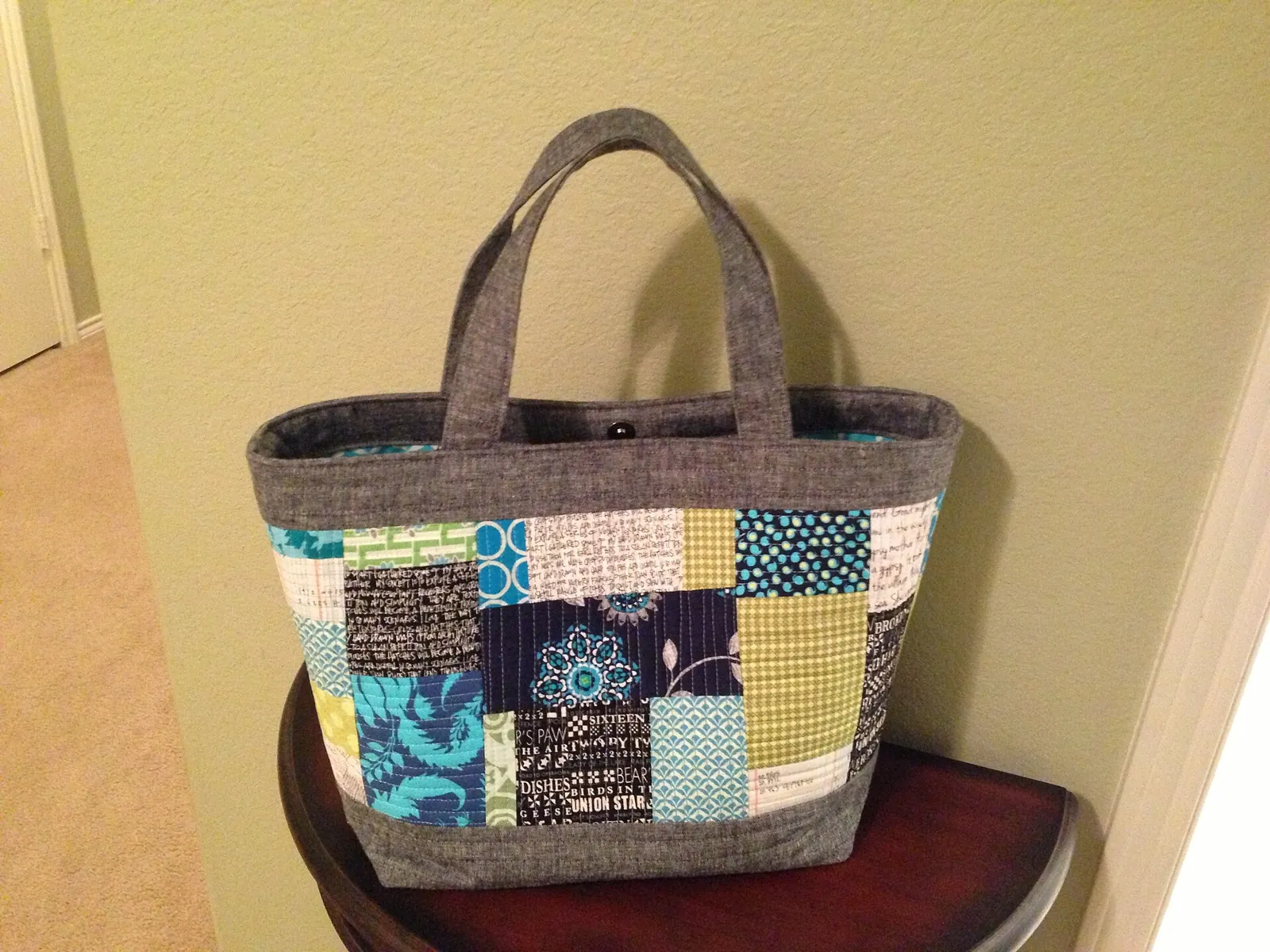
Image credits. Top image: Sew Sew Modern Swap Finished - Flickr - Lori Hartman Designs by Lori Hartman Designs, CC BY 2.0, via Wikimedia Commons
Spotted something out of date or a gift that's no longer available? Tell our editors — we review every correction.