Air-dry clay heart dishes for Valentine's Day
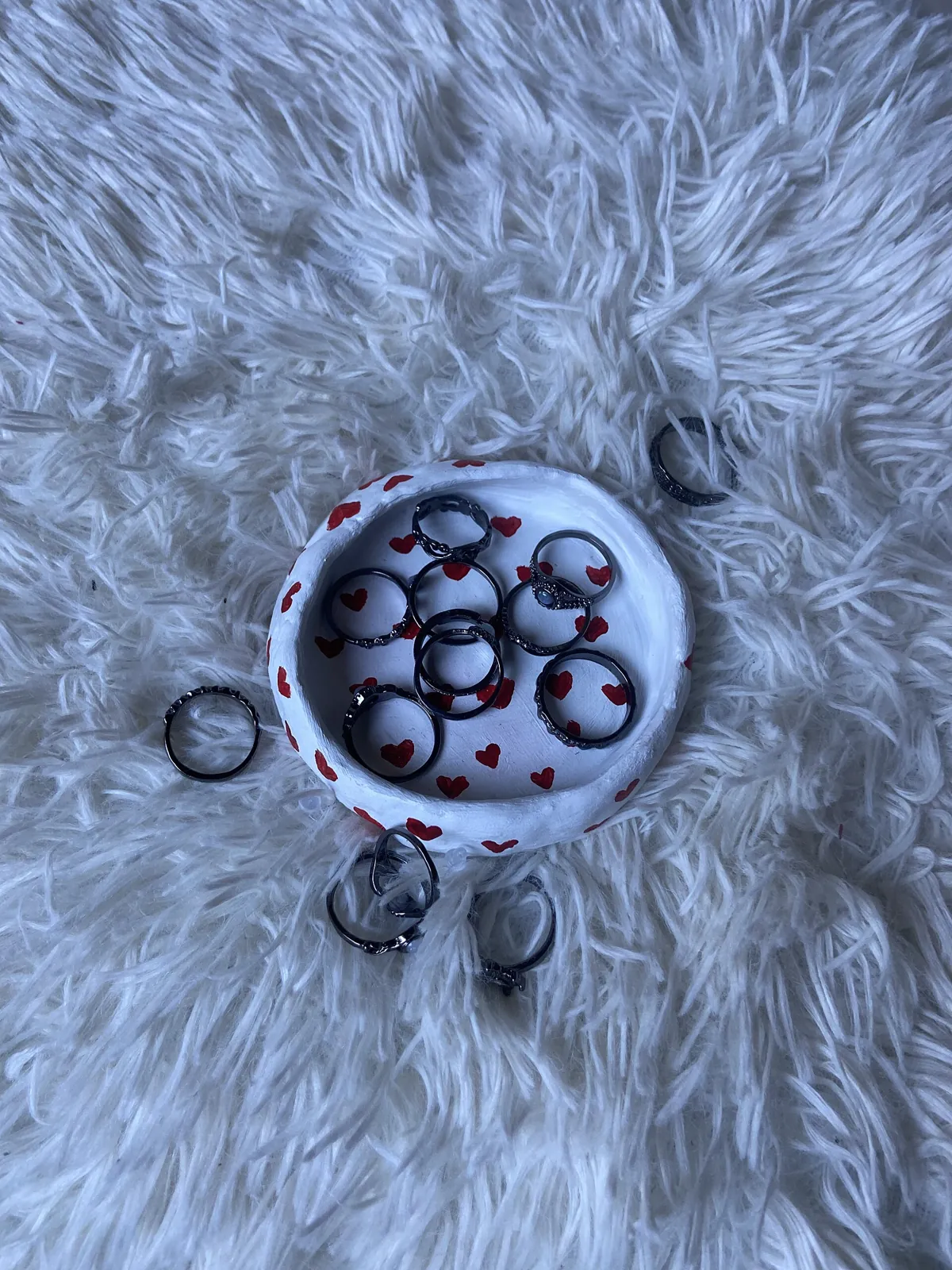
A heart-shaped ring dish with a stamped message, made at the kitchen table with air-dry clay, paint and varnish. No kiln, no oven.
Quick answer
Roll air-dry clay into an even slab, cut it with a paper heart template, stamp a word or initials into it, and curve the edges by setting it in a shallow bowl. Let it dry completely as your clay's package directs (Crayola, for example, says 24 hours to the touch and 72 hours to dry completely), then paint and seal it with acrylic varnish. It makes a lovely ring or keepsake dish, but it is decorative only: sealing does not make air-dry clay waterproof, and it should not hold food.
- Time About 1 hour of work, plus 3 or more days of drying
- Difficulty Easy
- Cost $10 – $25 for clay, paint and varnish
- Makes 3–5 small heart dishes from a 1 lb (about 500 g) block
A heart-shaped dish for rings, earrings or a few folded love notes is a Valentine that keeps being useful long after the chocolate is gone. Air-dry clay hardens on exposure to air, with no baking or kiln, so you can make it at the kitchen table. If you have already made our round air-dry clay trinket dish, this version adds Valentine details: a heart shape, stamped messages, a gold rim and a nested pair for two. More projects live in our clay and resin section.
What you need
- Air-dry clay, white or terracotta (one block makes several dishes)
- A rolling pin and two wooden slats or paint stirrers of equal thickness as rolling guides
- Parchment paper or a canvas mat
- Paper or thin card for a heart template
- A craft knife or a blunt butter knife
- Letter stamps, a toothpick or a pencil for writing into the clay
- A shallow bowl or saucer slightly larger than your heart, to shape the curve
- A small cup of water and a soft sponge
- Fine sandpaper (220 grit or finer) or a sanding sponge
- Acrylic paints, small brushes and a gold or metallic paint pen (optional)
- Acrylic varnish or sealer in matte, satin or gloss
Step-by-step instructions
Make the heart template
Fold paper in half, draw half a heart against the fold and cut it out. A heart about 4 inches across holds rings and earrings without taking over a nightstand. For a nested pair, cut a second template about an inch smaller.
Roll an even slab
Knead a piece of clay until smooth, place it between the two slats on parchment and roll until the pin rides on the guides. Roughly 1/4 inch is a sturdy thickness for a small dish. Even thickness matters more than the exact number, because thick and thin areas dry at different speeds and that is a common cause of warping and cracks.
Cut the heart
Lay the template on the slab and cut around it with the knife held straight up. Pull the excess away rather than lifting the heart, and wrap leftover clay tightly in plastic so it stays workable.
Smooth and personalize
Dampen a fingertip and run it around the cut edge to round it. Use as little water as possible; a soggy surface cracks as it dries. Now press in your message: letter stamps for a word such as "love" or "always," two initials, or a date. Keep impressions shallow so they do not weaken the slab. A heart-shaped cookie cutter pressed lightly into the center leaves a pretty outline.
Shape the curve
Lift the heart on its parchment and lower it gently into the shallow bowl so the edges curve up. Alternatively, pinch the rim up slightly with your fingers all the way around. Check that the base sits flat so the finished dish will not rock, then smooth any fingerprints with a barely damp sponge.
Dry it slowly and completely
Leave the dish at room temperature, away from radiators and direct sun, and follow the drying time on your clay's packaging. Crayola says its Air-Dry Clay generally takes 24 hours to dry to the touch and 72 hours to dry completely, and that drying times change with conditions and the size of the piece. Once the dish holds its shape, take it out of the bowl and turn it over so the underside can dry too. It is fully dry when it feels room temperature rather than cool and the color has lightened evenly.
Sand and paint
Sand the rim and any rough spots lightly, working over a damp paper towel to catch dust, and wipe the dish clean. Paint with acrylics: a blush pink or deep red interior with a white outside, or leave the clay natural and add only a gold rim with a paint pen. Paint stamped letters in a contrasting color, then wipe the surface with a damp cloth so the paint stays only in the impressions.
Seal it
When the paint is dry, brush on an acrylic varnish in thin coats, letting each coat dry as the label directs. Crayola recommends sealing its clay with an acrylic varnish only once the piece is completely dry, and testing the varnish on a scrap first to make sure the two are compatible. Varnish protects the paint and makes the dish easier to dust, but it does not make it waterproof.
Tip: Make two or three hearts at once. Drying is the slow part, and having a spare means a crack or a smudged letter is no disaster.
What it is for (and what it is not)
An air-dry clay heart dish is a decorative piece. It is perfect for:
- Rings, earrings and a watch on a nightstand
- Keys or a lip balm by the door
- Folded love notes, a few paper hearts or a small wrapped candy
- Holding a tea light in a glass holder, never a bare flame or candle directly on the clay
Keep it away from water and food. Crayola states that sealing its Air-Dry Clay will not waterproof it, so do not use the dish as a soap dish, a spoon rest, a plant saucer or anywhere it might sit wet. None of the manufacturer pages we consulted describe air-dry clay as food-safe, even when varnished, so do not serve candy or snacks directly in it. If you want a dish for food or water, look for a kiln-fired ceramic made with food-safe glazes instead.
Safety notes
- Sharp tools. An adult should handle the craft knife. Children can cut clay safely with a blunt butter knife or cookie cutter.
- Varnish and paint. Use them in a ventilated room and follow the label, including any age guidance and drying times.
- Sanding dust. Sand gently over a damp towel or outdoors and avoid breathing the dust.
- Kids. Air-dry clay is a popular family craft; check the age range on your particular product and supervise younger children, who should not put clay in their mouths.
- Drying. The clay is designed to harden without heat. Follow your package instead of trying to speed it up with an oven or hair dryer unless the manufacturer says that is fine.
Valentine variations
- Nested pair. Make a large and a small heart and give them stacked, one for each of you.
- Thumbprint heart. Press two thumbprints together at an angle in the center to form a small heart, then paint around it.
- Terrazzo style. Knead small flecks of colored clay into white clay before rolling for a speckled look.
- Love-note dish. Fill the finished dish with a few tiny rolled notes or pair it with our memory jar idea.
- Jewelry set. Give it with a pair of handmade earrings from our polymer clay earrings tutorial.
How to package it as a gift
Wrap the finished dish in tissue and set it in a small box with crinkle paper so the rim cannot chip. Tuck a ring, a pair of earrings or a few chocolates in their wrappers inside the dish for the reveal. Add a care card that says "Decorative only: keep dry, wipe with a dry cloth, not for food," so the recipient knows how to look after it. For more ideas for the day, see our DIY Valentine's collection and the Valentine's Day gift guide.
Frequently asked questions
How long does air-dry clay take to dry?
It depends on the brand, thickness and room conditions, so follow your package. Crayola says its Air-Dry Clay generally takes 24 hours to dry to the touch and 72 hours to dry completely. Thicker pieces and humid rooms take longer.
Is an air-dry clay dish waterproof once sealed?
No. Crayola states that sealing its Air-Dry Clay will not waterproof it. Varnish protects the surface from dust and light handling, but the dish should stay dry.
Can I put candy or food in an air-dry clay dish?
Not unwrapped food. We found no manufacturer guidance describing air-dry clay as food-safe, even varnished. Use it for jewelry and keepsakes, and put only individually wrapped candy in it.
Why did my clay dish crack?
Common causes are uneven thickness, too much water when smoothing, and drying too fast near heat or sun. Small hairline cracks can often be filled with a little clay paste (clay mixed with water), left to dry, then sanded.
Sources
- Crayola — How long does it take for Air-Dry Clay to dry? crayola.com
- Crayola — Can Air-Dry Clay pieces be sealed? crayola.com
- FILA — DAS modeling clay product page. fila.it
Image credits. Top image: Clay tablet hearts by Sram4511, CC BY-SA 4.0, via Wikimedia Commons
Spotted something out of date or a gift that's no longer available? Tell our editors — we review every correction.