Why do we give flowers as gifts? History and meaning
Flowers wilt in a week, yet we keep giving them. Here is where the custom comes from, what bouquets communicate and when they are the right gift.
We independently research every pick. If you buy through our links we may earn a small commission, at no extra cost to you. As an Amazon Associate we earn from qualifying purchases. Affiliate disclosure.
Quick answer
We give flowers because they say something words often cannot: they are beautiful, they do not last, and centuries of custom have given them meaning. People have attached symbolism to flowers since ancient times, the 19th-century “language of flowers” made bouquets a way to send messages, and occasions such as Mother's Day built their own flower traditions. Research from Rutgers University also suggests that receiving flowers reliably makes people smile.
- Main reasons Beauty, emotion, symbolism, tradition
- Language of flowers Peaked in the 19th century in Britain, France and the US
- Typical bouquet $35 – $100
- Best rule Match the flower to the person and the occasion
Why do we give flowers as gifts, when they wilt within a week? That short life is part of the answer. A bouquet is not meant to be kept; it marks a moment, a feeling or an occasion, and it brings color into a room while that feeling is fresh. This explainer looks at where the habit comes from, what flowers can communicate and when they are the right choice. It is part of our why we give series. For a guide to what individual blooms and colors mean, see our flower meanings guide.
Why do we give flowers as gifts? The short history
Ancient roots
Cornell University Library's online exhibition on the language of flowers notes that giving flowers symbolic meaning is an ancient practice, with roots in China, Egypt and Assyria. Clemson University's Home & Garden Information Center adds that red roses were associated with Aphrodite, the Greek goddess of love and beauty, and that giving flowers on Valentine's Day draws on Greek, Roman and medieval traditions.
The Victorian language of flowers
The idea that each flower carries a specific message, called floriography, became a fashion in the 19th century. Clemson credits the poet Lady Mary Wortley Montagu with introducing it to European culture in 1718. Cornell's exhibition gives a more cautious view: it says European flower languages are often wrongly traced to Turkey, where the practice used many objects besides flowers, and that the British fashion largely came from France.
Either way, the craze took off among the growing middle classes of Britain, France and the United States. According to Cornell, flower dictionaries became standard in middle-class homes, many were given as gifts, and for women who were largely shut out of public debate, the language of flowers offered a way to write about values and feelings. Clemson notes that strict Victorian etiquette discouraged open talk of love or rejection, so flowers could carry what could not be said aloud. By the later 1800s, the fashion was popular enough to be parodied in the British magazine Punch.
Holidays that made flowers a habit
Some modern flower traditions are surprisingly recent. The Library of Congress explains that Anna Jarvis, the founder of Mother's Day, wore a white carnation, her late mother's favorite flower, and donated 500 white carnations to Mother's Day observances in Grafton, West Virginia. A florists' trade paper credited her in 1911 with proposing the white carnation as the holiday's flower. The same Library of Congress article notes that florists adopted the slogan “Say it with flowers” for a Mother's Day campaign in 1918, helped by a flower wire service set up in 1910 that let florists in different cities pass orders to each other, making it possible to send flowers over long distances.
What flowers say when you give them
Most people today do not consult a flower dictionary, but some meanings have stuck. The Clemson extension service lists red roses for love and passion, pink for grace, admiration and gratitude, white for innocence, purity and reverence, and yellow for friendship, gladness and joy. Lists vary between sources and countries, so treat meanings as a bonus rather than a rule. Many people also choose flowers by birth month; our guide to birth flowers by month explains those.
Beyond symbolism, flowers signal effort. Choosing, buying and delivering something perishable shows you thought about the person at a particular moment, which is why flowers suit apologies, congratulations and sympathy as much as romance.
Are flowers a good gift? What research suggests
A set of studies led by psychologist Jeannette Haviland-Jones at Rutgers University, published in 2005 in the journal Evolutionary Psychology, tested how people react to flowers. As described in the university's press release, all 147 women who received a bouquet smiled, while some who received a candle or a fruit basket did not. In a second study, people given a flower in an elevator smiled, talked more and stood closer to others than those given a pen or nothing. A third study in a retirement community linked receiving flowers with better mood and memory. The samples were small and the authors' evolutionary explanation is a hypothesis, but the results fit what most people notice: flowers tend to produce a genuine smile.
So are flowers a good gift? Usually yes, as long as they suit the person. They are less welcome for someone with pollen allergies or a sensitive sense of smell, in some hospital units, or when a grieving family has asked for donations instead.
Occasions where flowers are the classic gift
Mother's Day carnations or a mixed bouquet
Why it works: Carnations carry the holiday's own history, and a seasonal mixed bouquet in her favorite colors is never wrong.
Skip it if: she prefers plants that last; a flowering potted plant does the same job for months.
Valentine's Day roses
Why it works: Red roses are the most recognizable romantic gesture, and pink or mixed colors feel lighter for a newer relationship.
Skip it if: they have said roses feel cliché; their favorite flower says more.
Sympathy flowers or a plant
Why it works: Flowers at a funeral or delivered to the home are a quiet sign of support. A plant can stay as a living reminder.
Skip it if: the family asked for donations; see our sympathy gifts instead of flowers.
Get-well, thank-you and hosting bouquets
Why it works: A small arrangement brightens a recovery room or thanks a host without adding clutter. Choose low-scent flowers in a stable vase.
Skip it if: they are still in hospital; check the unit's rules first.
Birthday and congratulations bouquets
Why it works: A birth-month flower or their favorite color makes a bouquet personal. Our flower delivery guide explains how to order and send well.
Skip it if: you know they love something else; flowers work best alongside a personal gift, not instead of it.
How to give flowers well
- Think about the person, not the default. Their favorite flower or color beats a generic dozen roses.
- Check practical limits. Allergies, pets, small apartments and hospital rules all matter.
- Add a note. One handwritten line turns a bouquet into a message.
- Consider a plant. Potted flowers and herbs last for months and suit people who dislike waste.
Frequently asked questions
Why do people give flowers?
To express feelings such as love, gratitude, sympathy or congratulations. Flowers combine beauty with long-standing symbolism, and studies suggest they reliably make recipients smile.
What does it mean when a guy gives you flowers?
Usually that he wants to show he is thinking of you, whether out of romantic interest, appreciation or apology. The context, the note and the flower matter more than any dictionary meaning; red roses tend to signal romance, while yellow flowers are often read as friendship.
When did the language of flowers start?
Symbolic meanings for flowers are ancient, but the fashion for flower dictionaries peaked in the 19th century in Britain, France and the United States. Sources differ on its exact origins.
Is it okay to give flowers to a man?
Yes. Flowers, plants or a single bloom are a thoughtful gift for anyone who would enjoy them. A potted plant or a bold arrangement in deep colors suits people who prefer something less traditional.
Sources
- Cornell University Library — Written in Petals: The language of flowers in Victorian Europe, History. exhibits-prod.library.cornell.edu
- Clemson Cooperative Extension, Home & Garden Information Center — The secret language of flowers for Valentine's Day. hgic.clemson.edu
- Library of Congress, Inside Adams blog — Say it with flowers (2010). blogs.loc.gov
- ScienceDaily (Rutgers University press release) — The evolutionary triumph of flower power (2005). www.sciencedaily.com
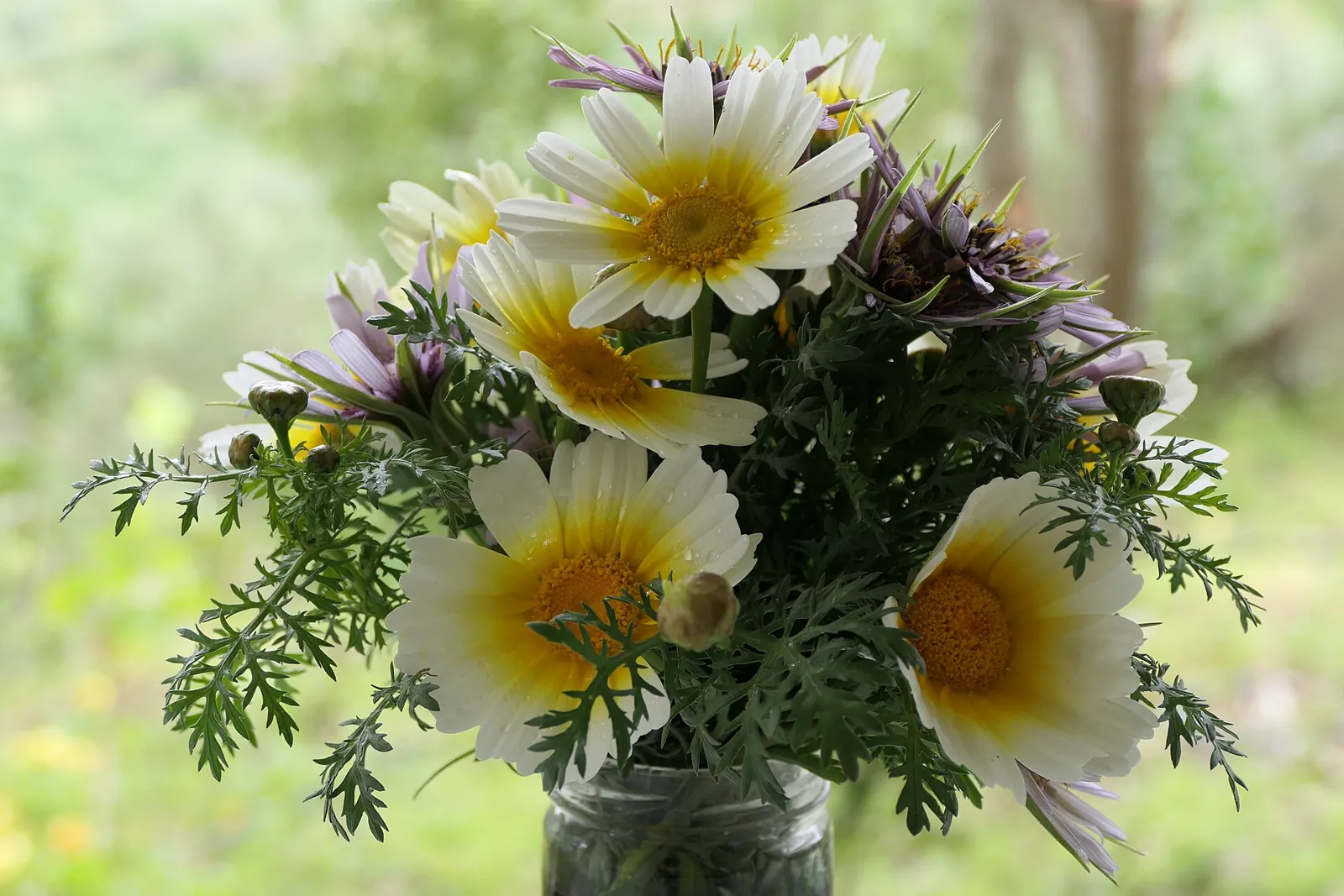
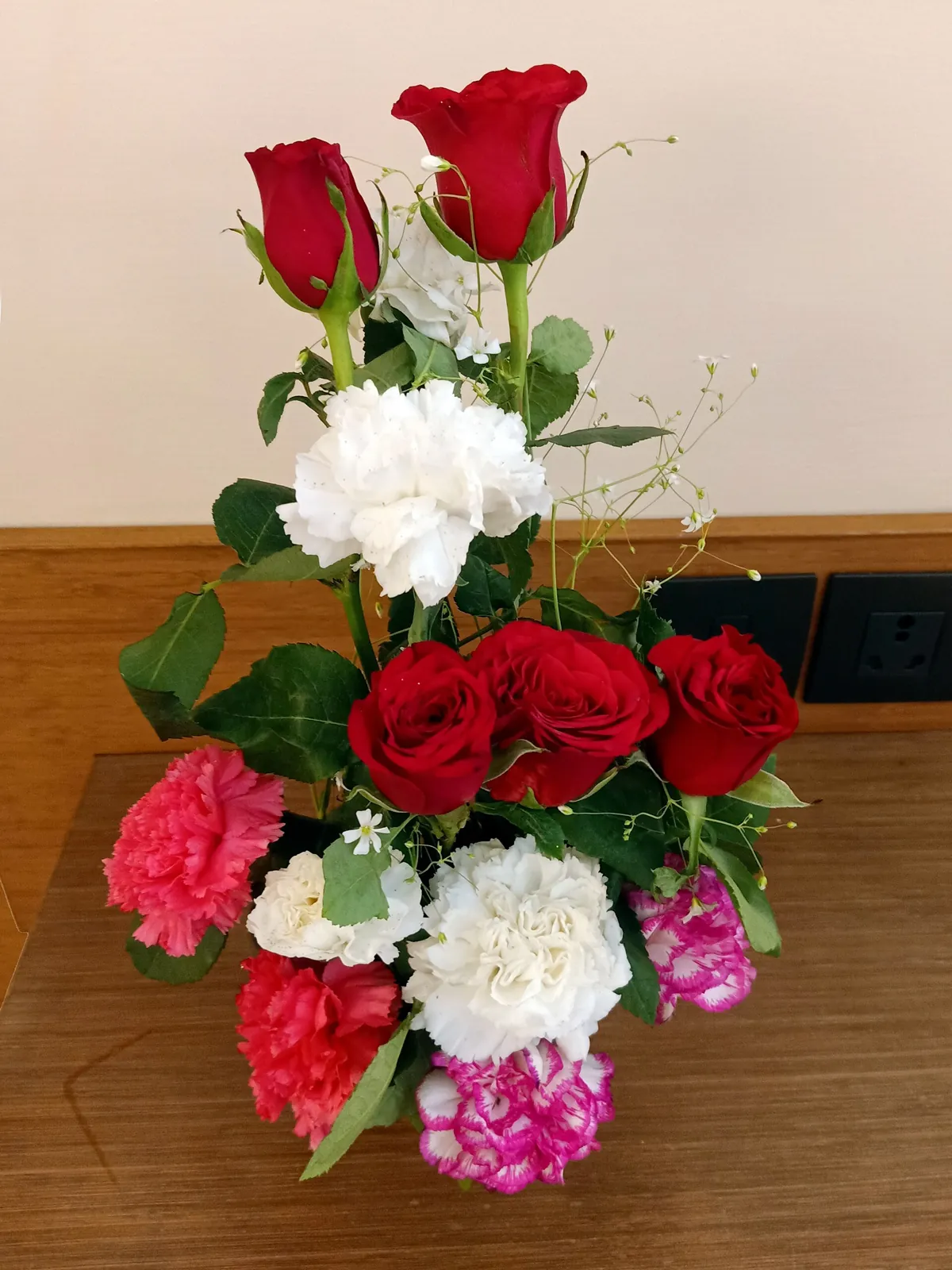
Image credits. Top image: Flower-bouquet-wild-flowers-Sitia-Crete-Greece by Petro Stelte, CC BY-SA 4.0, via Wikimedia Commons · In-article image: Rose and carnation flower bouquet 01 by Suyash Dwivedi, CC BY-SA 4.0, via Wikimedia Commons
Spotted something out of date or a gift that's no longer available? Tell our editors — we review every correction.