DIY Christmas candles in jars and teacups
Holiday-scented soy candles poured into jars and vintage teacups, with the container checks, wick testing and safety card that make them a gift worth giving.
Quick answer
To make Christmas candles as gifts, melt a container soy wax in a double boiler, add a candle-safe holiday fragrance at the temperature and percentage your wax maker specifies, and pour it into heat-safe jars or sturdy, crack-free teacups fitted with a wick sized for that container's diameter. Let them set, cure for about two weeks, test-burn one from each batch, and attach a short safety card. Never leave melting wax or a lit candle unattended.
- Time About 1 1/2 hours hands-on, plus 24 hours to set and up to 2 weeks to cure
- Difficulty Easy to moderate
- Cost About $35 – $70 for wax, wicks, fragrance and a thermometer; containers extra
- Makes About four 8 oz candles from 2 lb of wax
A homemade candle smells like the season and gets used rather than stored. This tutorial covers holiday container candles in jars and vintage teacups and how to make them gift-ready. New to pouring? Our guide to making soy candles covers the basics.
Choose safe containers: jars and teacups
The container is the part of a candle most likely to fail, so choose it before anything else.
- Jars: Buy jars sold for candle making, or thick, straight-sided canning-style jars. Lone Star Candle Supply advises pouring into containers the manufacturer has cleared for candle use and warns that repurposed and thrift-store glass can crack or fracture at candle-making temperatures.
- Teacups: Choose thick porcelain or stoneware cups with a wide, open shape. Run a fingernail around the rim and inside: reject any cup with a crack, chip or fine crazing in the glaze, and skip delicate eggshell-thin china.
- Avoid: Thin drinking glasses and anything wooden or plastic; Health Canada warns such holders can catch fire.
- Measure the inside diameter of each container. You need it to pick a wick.
What you need
- 2 lb (about 900 g) container soy wax, such as a 464-type wax
- Pre-tabbed cotton wicks in the series and size your wax supplier recommends for your container diameter
- Candle-safe fragrance oil in a Christmas scent (fir, cinnamon, orange and clove, vanilla, peppermint)
- Four 8 oz heat-safe jars or teacups, washed and completely dry
- Wick stickers or glue dots, and wick centering bars or clothespins
- Pouring pitcher with a heat-safe handle, set in a saucepan of water as a double boiler
- Kitchen scale and a candy or digital thermometer
- Paper towels, oven mitts, a lid or baking sheet kept within reach
- Labels, ribbon and small cards for the safety instructions
Wax, wicks and fragrance: follow the manufacturer
The numbers below come from one manufacturer for one wax. Use the figures on your own wax and fragrance labels.
- Wax: CandleScience lists Golden Brands 464 soy wax with a melt point of 113°F (45°C) and notes it can be too soft for summer heat. That is no problem at Christmas, but do not leave finished candles in a hot car.
- Fragrance load: For 464 in containers, CandleScience lists 10%, or 1.6 oz of fragrance per pound of wax, as the load. Treat the wax maker's figure as a ceiling, check your fragrance oil's own maximum for candles, and never add more in the hope of a stronger scent; excess oil can cause soot and burn problems.
- Temperatures: For 464, CandleScience says to heat the wax to 185°F (85°C) in a double boiler, add fragrance, stir for two minutes off the heat, and pour at 135°F (57°C). Other waxes use different numbers.
- Wicks: Wick suppliers publish charts: find your wax, then your container's diameter, and the chart suggests a size. CandleScience says to go up a size or two for heavy fragrance or a lot of dye and down for light fragrance or no dye, and to confirm with a test burn. Teacups are often wider than jars, so they may need a larger wick or two wicks.
- Fragrance only, not food oils: Use oils sold as candle-safe. Kitchen extracts and cooking oils do not belong in a candle.
How to make Christmas candles
Set up a safe workspace
Clear the counter, keep children and pets out of the kitchen, and put a lid or baking sheet within reach. Melting wax should never be left alone, even for a minute. Warm the clean containers slightly in a low oven or with a hair dryer so the wax sticks evenly.
Fix the wicks
Stick a pre-tabbed wick to the center of each container's base with a wick sticker or glue dot. Press it down firmly, then hold the top straight with a centering bar or clothespin laid across the rim.
Weigh and melt the wax
Weigh the wax, not by volume, and place it in the pouring pitcher sitting in a pan of simmering water. Clip the thermometer to the pitcher and watch it the whole time. Never melt wax directly over a burner.
Add the fragrance
When the wax reaches the temperature your wax maker specifies, take it off the heat, weigh in the fragrance oil within the stated limit, and stir gently but thoroughly for about two minutes so it binds with the wax.
Cool and pour
Let the wax cool to the recommended pour temperature, then pour slowly into each container, stopping about 1/2 inch below the rim. Save a little wax in case the tops sink and need a second thin pour.
Let the candles set
Leave the candles to harden for at least 24 hours on a wooden board or folded towel, away from drafts. CandleScience warns against cooling them on marble or granite, which pulls heat out too quickly.
Trim and cure
Remove the centering bars and trim each wick to 1/4 inch. Put a lid or cover on the candles and let them cure; CandleScience suggests two weeks for the best scent throw with 464 wax.
Test-burn one candle
Before gifting, burn one candle from the batch for three to four hours. CandleScience describes a good result as a steady flame about 1 inch tall, a melt pool that reaches the edge, about 1/4 to 3/4 inch deep, and no smoke or soot. If the flame is tall and smoky, or the container gets uncomfortably hot, try a smaller wick before you make more.
Tip: Make a small test batch with two or three wick sizes in the same container, label each one, and burn them side by side. It is the quickest way to find the right wick for an unusual teacup.
Fire safety for you and the recipient
- Never unattended: The National Candle Association says not to leave burning candles unattended and to put them out before bed or when leaving a room.
- Distance: Keep lit candles at least 12 inches from anything that can burn, including curtains, greenery and wrapping paper, and on a stable, fire-resistant surface.
- Stop before the bottom: Kidde advises putting out container candles before the last half-inch of wax starts to melt. This protects the glass or china from overheating; Health Canada also warns that glass holders can break when they get too hot.
- Trim the wick: Health Canada recommends trimming wicks to about 1/4 inch before lighting and keeping burning candles out of reach of children and pets.
- Keep decorations outside the wax: Cinnamon sticks, dried orange slices and sprigs of greenery look lovely, but tie them to the outside of a jar or lid, never into the wax where they can catch fire.
- If wax catches fire while melting: Turn off the heat and smother it with a lid or baking sheet, as the U.S. Fire Administration advises for pan fires. Do not throw water on hot wax.
How to package candles as gifts
Add a lid or a circle of fabric tied with ribbon to keep dust off the wax, and tuck a small card in each one. A good card reads: Scent, wax type, date poured. Trim wick to 1/4 inch before each lighting. Burn on a heat-safe surface, never unattended, away from children, pets and anything that can burn. Stop when 1/2 inch of wax remains. Our tutorial on making gift tags has templates that fit candle jars well.
Wrap teacup candles in tissue and nest them in a small box with crumpled paper so the handle cannot snap. A candle pairs naturally with a bar of melt-and-pour soap in the same scent, and you will find more ideas in our roundup of DIY Christmas gifts and the candles and soap section.
Frequently asked questions
Can I make a candle in any teacup?
No. Use thick porcelain or stoneware with no cracks, chips or crazing, and a wide opening. Thin china and cups with damage can crack from heat. Always test-burn one cup of that style first.
How much fragrance oil should I add?
Use the percentage your wax manufacturer lists and stay under your fragrance oil's own maximum. For example, CandleScience lists 10% (1.6 oz per pound) for 464 soy wax in containers. More oil does not always mean more scent and can cause soot.
How long should homemade candles cure before giving?
Soy candles usually smell stronger after curing. CandleScience suggests two weeks for 464 wax, so pour your Christmas candles by early December.
Can kids help make candles?
Older children can choose scents, decorate jars and write labels, but an adult should handle all melting, pouring and lighting.
Sources
- CandleScience — Golden Brands 464 Soy Wax (product and instructions). candlescience.com
- CandleScience — How to properly wick container candles. candlescience.com
- Lone Star Candle Supply — Candle Making Safety Tips. lonestarcandlesupply.com
- National Candle Association — Fire Safety Tips. candles.org
- Health Canada — Candle Safety. canada.ca
- Kidde — Candle Safety. kidde.com
- U.S. Fire Administration — Cooking Fire Safety. usfa.fema.gov
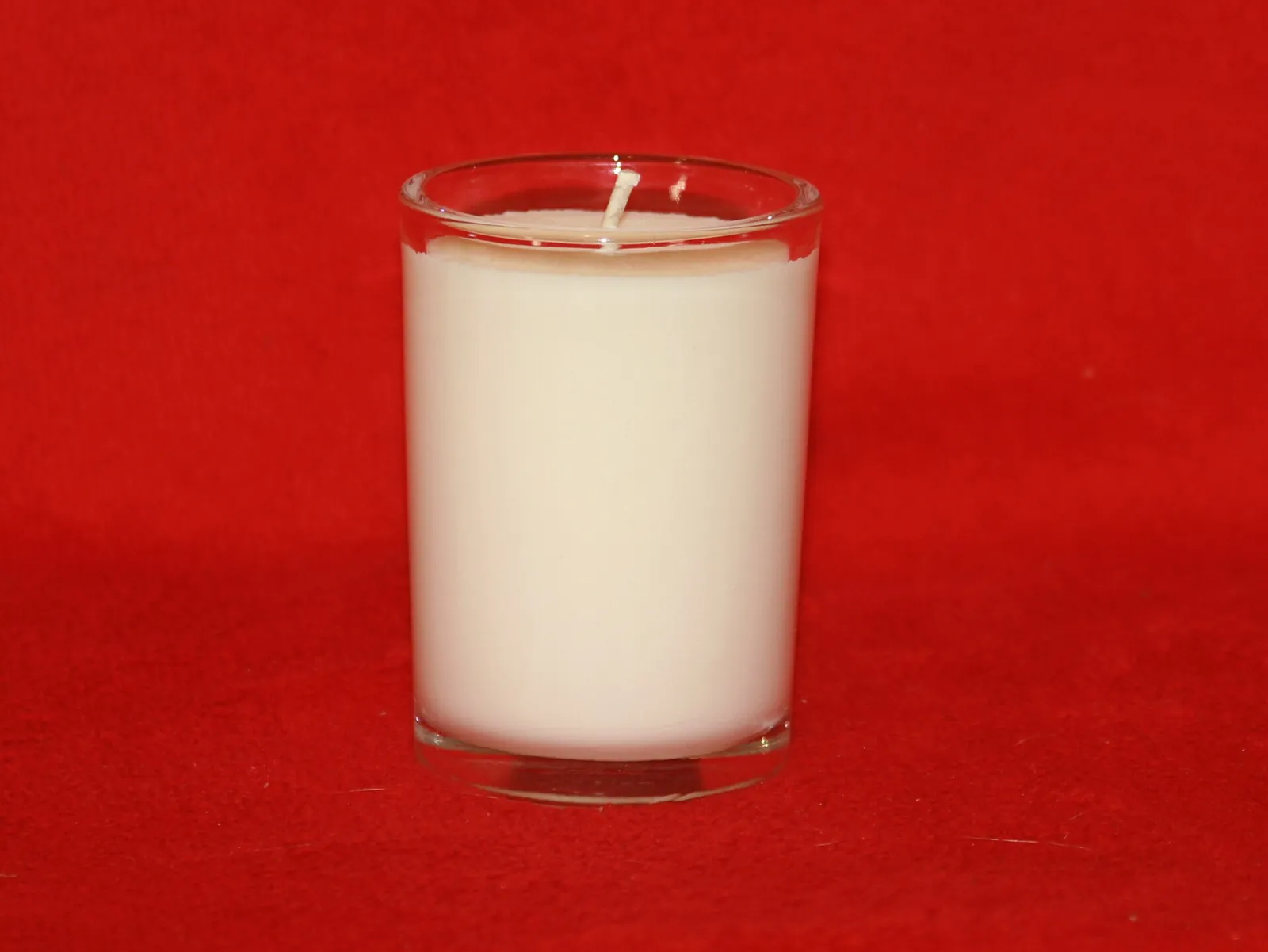
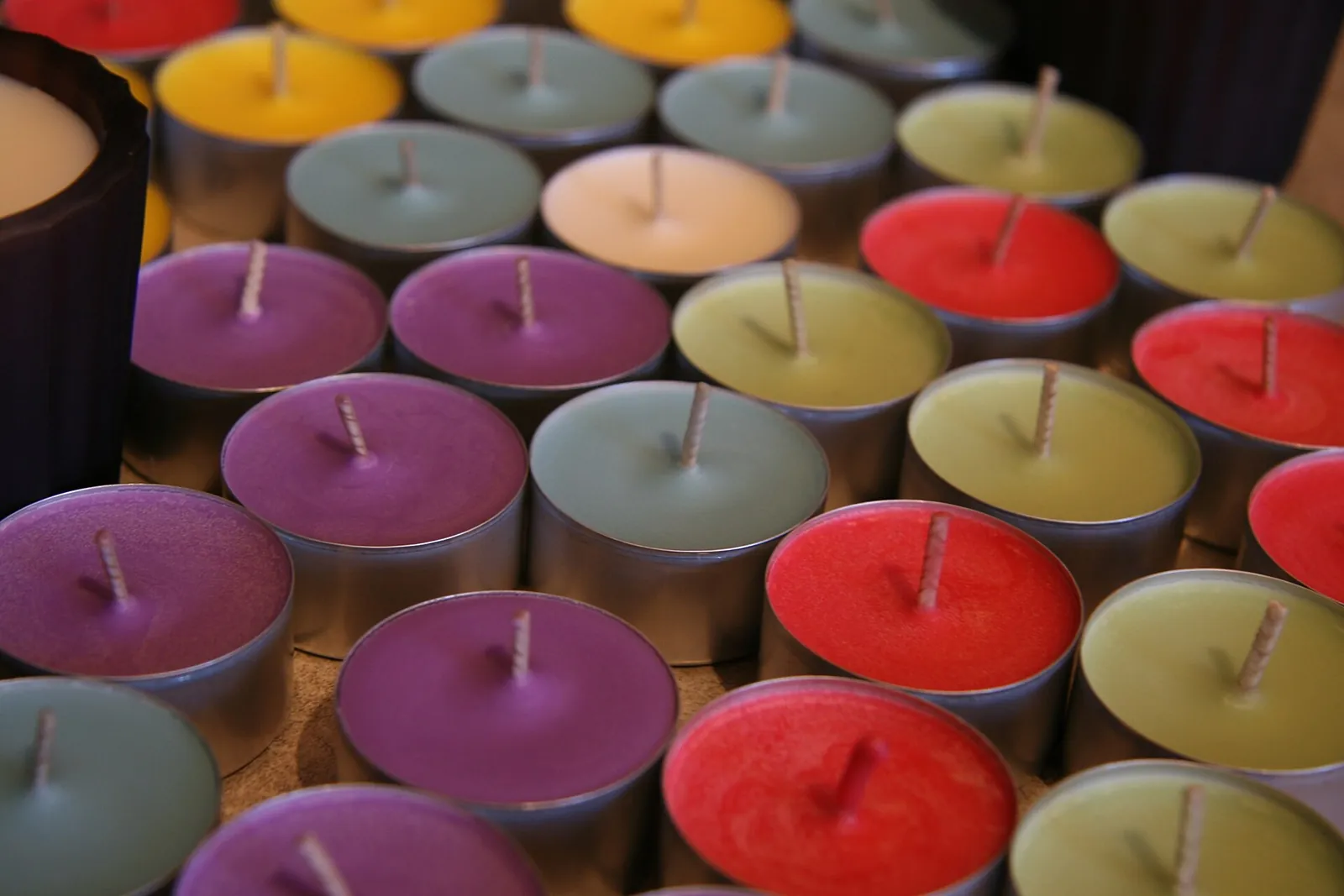
Image credits. Top image: Single plain soy candle by mikehipp, CC BY-SA 2.0, via Wikimedia Commons · In-article image: Soy tealight candles by lindsay.dee.bunny, CC BY 2.0, via Wikimedia Commons
Spotted something out of date or a gift that's no longer available? Tell our editors — we review every correction.