Printable recipe cards to give with a food gift
Free recipe cards in the two standard US sizes, with backs for allergens and storage notes, ready to tie to a jar or tin of homemade food.
Quick answer
Download the free PDF, print it at actual size (100%) on 80 – 110 lb cover cardstock, and cut along the dashed lines. You get recipe cards in the two standard US sizes, 4 × 6 in and 3 × 5 in, each with a matching back for long directions, allergens and storage notes. Write the recipe by hand and tie the card to a jar, tin or box of homemade food.
Download the free PDF (US Letter)
Recipe cards in French and German on A4 use the European index-card sizes A6 (105 × 148 mm) and A7 (74 × 105 mm): French (Recette) and German (Rezept).
- Time 15 minutes to print and cut, plus writing time
- Difficulty Easy
- Cost Under $1 per sheet set
- Makes 2 large (4 × 6 in) and 3 small (3 × 5 in) cards, each with a back
What's in the PDF
The file has four pages. Fronts and backs are on separate pages so you can print them back to back or as separate cards.
- Page 1: two 4 × 6 in fronts. A blush header with "Recipe" and a line for the dish's name, then From the kitchen of, Serves, Prep and Cook, and two lined columns: Ingredients and Directions.
- Page 2: two 4 × 6 in backs. Directions, continued, plus a gift block: Contains (for allergens), Storage, Best by, and Made with love by … on ….
- Page 3: three 3 × 5 in fronts with the same layout, a little more compact.
- Page 4: three 3 × 5 in backs.
The 3 × 5 in size is the classic North American index card, and 4 × 6 in is the other widely sold size, so the cards slip into the recipe boxes and plastic sleeves you can already buy. On A4 the files use A6 and A7, the ISO sizes commonly used for index cards outside North America.
What you'll need
- The PDF and a PDF reader
- Matte white or ivory cardstock: 80 lb cover (about 216 g/m²) is sturdy for a recipe box; 110 lb cover (about 298 g/m²) feels like a real index card but not every home printer can feed it; 65 lb cover (about 176 g/m²) works if that's what your printer handles
- A printer that accepts cardstock
- A paper trimmer, or a metal ruler and craft knife on a cutting mat
- A fine-tip permanent pen; kitchen cards get splashed, so water-resistant ink is worth it
- Optional: a corner rounder punch, a hole punch and ribbon or twine to attach the card to a gift
How to print and make the cards
Print at actual size
Choose Actual size or 100% scaling and turn off "Fit to page," otherwise the cards won't fit standard recipe boxes. Use the cardstock or heavy-paper setting and the manual feed tray if there is one.
Decide on single or double-sided
For double-sided cards, print page 1, put the sheet back in the tray to print on the other side, and print page 2 (pages 3 and 4 for the small cards). The cards are centered on the page, so fronts and backs line up when the sheet is flipped on its long edge. Printers feed differently, so run a test on plain paper first and mark which way up the sheet goes. If your printer has automatic duplex printing, choose "flip on long edge."
Or keep fronts and backs separate
For a recipe that fits on one side, just print the front pages. You can also glue a back to a front with a glue stick for a thicker, stiffer card.
Cut along the dashed lines
Use a trimmer for straight edges. The rose border sits slightly inside the cut line, so a cut that wanders by a millimeter or two won't show. Round the corners with a corner punch if you like; it helps cards slide in and out of a box.
Write the recipe
List ingredients in the order you use them, with amounts. Keep directions short and numbered. Note the pan size, oven temperature and time exactly as your recipe gives them, and add any tips the recipient will need, such as "bake until just set in the center."
Fill in the gift block
On the back, list what the food contains, how to store it and when to eat it by. Then sign and date it: Made with love by Grandma, December 2026.
Attach it to the gift
Punch a hole in one corner and tie the card to a jar neck or bag, or tuck it under the ribbon of a tin or box.
Tip: Photograph or scan each card before you give it away. Family recipes are easy to lose, and a digital copy means you can print a fresh card for the next person who asks.
Why the allergen line matters
Homemade food gifts often go to people whose dietary needs you don't fully know: a teacher, a coworker, a neighbor's family. In the US, the FDA names nine major food allergens: milk, eggs, fish, crustacean shellfish, tree nuts, peanuts, wheat, soybeans and sesame. Sesame became the ninth, with labeling on packaged foods required from January 1, 2023. Packaged-food labeling rules don't apply to home cooks, but a "Contains: wheat, eggs, milk, pecans" line on the card is a simple courtesy that lets the recipient decide safely. Mention shared equipment too if, for example, you baked nut-free cookies on the same sheet as peanut butter ones.
Use the Storage and Best by lines for practical notes: "Keep in an airtight tin, eat within a week," or "Refrigerate after opening." Base these on your recipe or a trusted source rather than guessing.
Food gifts that pair well with a recipe card
- Cookie or brownie mix in a jar: the card carries the "add butter and eggs, then bake" instructions. See our cookie mix in a jar tutorial.
- Homemade jam or preserves: include the recipe on the front and serving ideas on the back. Our guide to homemade jam as a gift covers jars and labeling.
- A family-recipe collection: write out a dozen favorite recipes and give them in a small box to a newlywed, a graduate moving into their first apartment, or a grandchild.
- The recipe behind the treat: when someone loves your holiday cookies, give the next batch with the recipe card attached. A Christmas cookie gift box has room for a 4 × 6 in card on top.
- Spice blends, granola or hot cocoa mix: a 3 × 5 in card on the jar with ingredients and how to use it.
Frequently asked questions
What size are standard recipe cards?
In the US, recipe cards are usually 3 × 5 in or 4 × 6 in, the common index-card sizes. This printable includes both. The A4 versions use A6 (105 × 148 mm) and A7 (74 × 105 mm).
What paper is best for printable recipe cards?
Matte cardstock of 80 – 110 lb cover (about 216 – 298 g/m²) holds up in a recipe box. If your printer can't feed heavy card, print on 65 lb cover and glue a front and back together.
How many recipe cards fit on one page?
Two 4 × 6 in cards or three 3 × 5 in cards fit on a US Letter sheet with safe margins for a home printer.
Can I type the recipe instead of handwriting it?
The cards are designed for handwriting, which makes them feel personal. If you prefer typing, print the blank card first, then run it through the printer again with a text document set to the same size, after testing on plain paper.
How do I protect recipe cards from kitchen spills?
Use permanent ink and slip the cards into clear plastic recipe-card sleeves. Laminating works too, but you can no longer add notes afterward.
Browse more homemade food gifts and our full collection of free printables.
Sources
- U.S. Food and Drug Administration — The FASTER Act: Sesame Is the Ninth Major Food Allergen. fda.gov
- Wikipedia — Index card (common sizes: 3 × 5 in, 4 × 6 in, A7). en.wikipedia.org
- Wikipedia — ISO 216 (A6 105 × 148 mm, A7 74 × 105 mm). en.wikipedia.org
- PaperSizes.org — US to International Paper Weights: Equivalent Weights & Conversions. papersizes.org
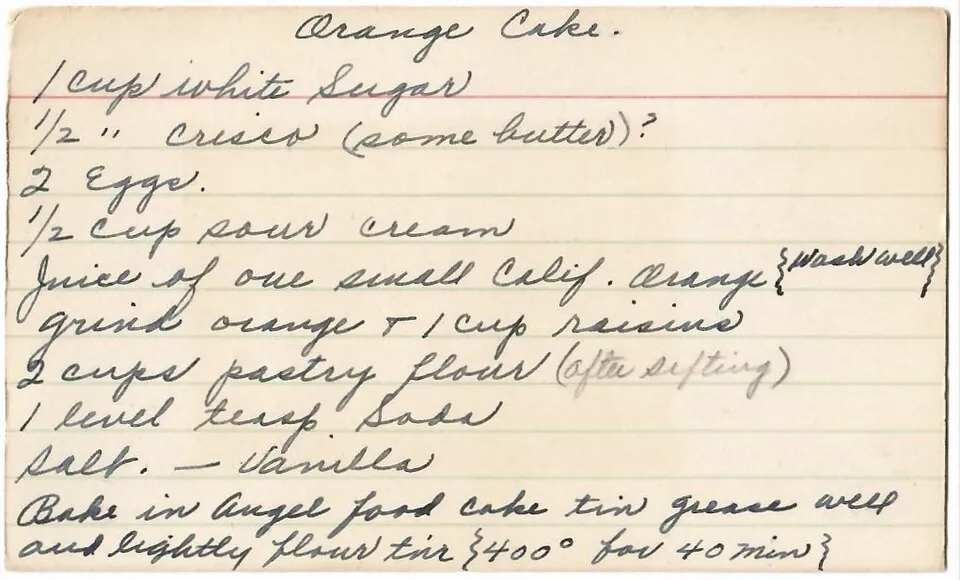
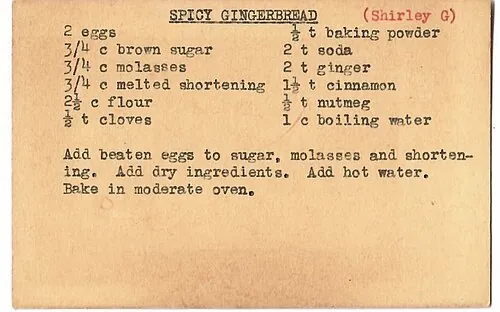
Image credits. Top image: Orange cake - Handwritten 2024-05-21 103943 page 1 by SJW, CC BY-SA 4.0, via Wikimedia Commons · In-article image: Spicy Gingerbread (Shirley G.) Handwritten 2024-05-21 103943 page 1 by SJW, CC BY-SA 4.0, via Wikimedia Commons
Spotted something out of date or a gift that's no longer available? Tell our editors — we review every correction.