Gift Etiquette in Tuvalu: Feasts, the Maneapa and Host Gifts
Tuvalu's community life centers on family, church and the island meeting hall. Here's what to give at a feast, how reciprocity works and how to be a good guest.
We independently research every pick. If you buy through our links we may earn a small commission, at no extra cost to you. Affiliate disclosure.
Quick answer
Community life in Tuvalu centers on the extended family, the church and the falekaupule, the island assembly of elders, whose meeting hall (the maneapa) hosts weddings, feasts and fatele dances. If you are invited to a feast in the falekaupule, a small gift is appropriate, and money is acceptable; if the feast is held in your honor and you receive a traditional gift, return a more impressive one. A gift to the elders is welcome but not expected. At home, remove your shoes, sit on the mat, and accept the coconut, toddy or tea you're offered. Dress modestly and keep Sundays quiet.
- Feast gift Small; money is acceptable
- Honored guest Reciprocate with a more impressive gift
- Say thank you "Fakafetai"
- Big days Tuvalu Day (October 1), Gospel Day, Christmas
What to give
Tuvalu's traditional community system remains strong. Each family has its own task, or salanga, to perform for the community, land is largely held by extended families (kaitasi), and communal life on each island runs under a council of chiefs supported by family heads. Gifts make most sense when they can be shared with the household or community, and gift exchange often runs both ways.
For a feast or community event
The Pacific Community's (SPC) cultural etiquette guide says it is appropriate to present a small gift when you are invited to a falekaupule feast, and that money is acceptable. If the feast is held in your honor, you will be presented with a traditional gift, and a more impressive reciprocal gift is appropriate. If you meet the chiefs and elders of the falekaupule, it is culturally acceptable to present them with a gift, though it is not expected.
For a host family
Tuvaluans are open and respectful with visitors, and hosts normally offer fresh toddy, green drinking coconuts or tea. A practical, shareable gift or a small specialty from your home country suits family-centered island life better than anything showy. Because Tuvalu is remote, ask your host in advance whether there's something useful you can bring.
For friends and in-laws
For Tuvaluan friends or in-laws, including families in New Zealand, Fiji or Australia, gifts that the wider family can enjoy together usually fit better than a personal luxury. For a wedding or another community event, ask a family member how guests from outside the family usually contribute.
A cash gift in an envelope for a feast
Why it works: Money is an acceptable gift when you are invited to a falekaupule feast.
Skip it if: the feast is in your honor and you need a larger, more impressive reciprocal gift; ask your host what is fitting.
Practical household goods
Why it works: Useful items the household can share suit family-centered island life.
Skip it if: your host suggests something else.
A specialty from your home country
Why it works: Easy to share and a good way to start a conversation.
Skip it if: it's alcohol; drinking is restricted outside licensed venues, and religion is central to daily life.
Books or school supplies for children
Why it works: Practical and easy to share among siblings and cousins.
Skip it if: you can't bring enough for every child in the household.
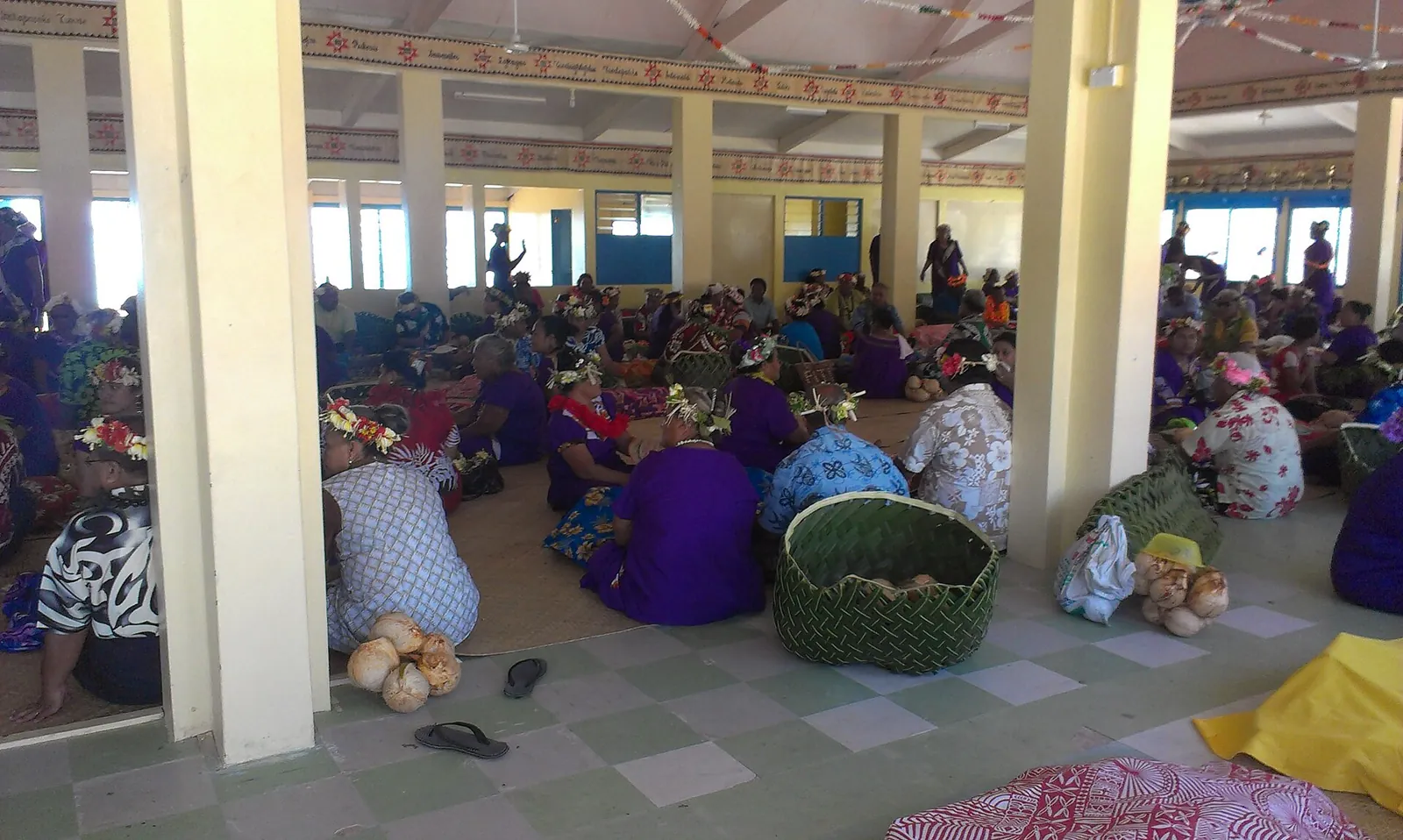
The maneapa and community occasions
Each island has a falekaupule, the traditional assembly of elders, which Tuvalu's constitution has recognized since 2023 as the traditional governing authority of the islands. Its meeting hall is where chiefs and elders deliberate and where weddings and community events are held.

By custom, people sit cross-legged in the falekaupule; women may sit with legs to one side, covered with a lavalava (wrap). Stretching your legs out in front of you during the formal part of a gathering is bad manners. During a meeting or function you may watch from a reasonable distance, but it is disrespectful to ride or drive a vehicle close by. If you are in a village during a traditional celebration, you will usually be welcomed and encouraged to join in. The fatele dance is performed at community events and to honor leaders and visiting dignitaries.
What to avoid
- Keeping your shoes on. Remove footwear before entering a home, church or meeting house.
- Stretching your legs out during the formal part of a gathering, especially inside the falekaupule.
- Passing above someone's head without apology. Say "Tulou" (excuse me) when you walk past someone sitting or lying down, or reach over them.
- Kissing on the cheek as a greeting. It is regarded as a foreign custom and frowned upon, especially on the outer islands, unless you know the person.
- Revealing clothing. Dress modestly; women should cover their thighs, and beachwear belongs at the beach or pool.
- Noisy Sunday activities. Virtually no work is done on Sundays, and people are expected to behave reverently.
- Showy or expensive gifts outside the feast context; in a close-knit community, modest and practical gifts are easier to accept.
How to give and receive
- Greet with "Talofa." A simple Talofa is adequate and appreciated; a handshake is a more formal greeting.
- Wait for a mat. In a home, remove your shoes and sit on the pandanus mat; if there isn't one, wait for one to be laid down.
- Accept or decline food politely. It's fine to say you've already eaten, but if your hosts insist, accept graciously.
- Wait for grace. Hosts usually say grace before a meal, and a guest is often invited to start eating first with the men or head of the family.
- Reciprocate. If you are honored with a traditional gift at a feast, respond with a more impressive gift of your own.
- Say "Fakafetai" (thank you) when you receive hospitality.
Holidays and occasions
Religion is a major part of Tuvaluan life, and on many islands the day begins and ends with family devotions. The Church of Tuvalu (Ekalesia Kelisiano Tuvalu) is the predominant church, and its pastor is a prominent figure on each island.
- Gospel Day (Te Aso o te Tala Lei), the second Monday in May.
- King's Official Birthday, usually the second Saturday in June.
- National Children's Day (Aso Tamaliki), the first Monday in August; a small gift or treat for children fits the day.
- Tuvalu Day (Independence Day), October 1, with the holiday continuing on October 2.
- Christmas (December 25) and Boxing Day (December 26), times for church, family and shared meals. See our Christmas ideas.
Business gifting
There is little published guidance on business gifts in Tuvalu. Official visits are arranged through government ministries, and meetings with island leaders go through the local council. At community feasts, the small-gift and reciprocity customs above apply. Otherwise keep any gift modest and open, such as a well-made item from your home country or organization, and avoid anything that could look like an inducement. Many organizations restrict gifts to officials, and anti-bribery laws in your home country may apply abroad. See our business gifts guide.
Frequently asked questions
What gift should I bring to a feast in Tuvalu?
A small gift; money is acceptable. If the feast is in your honor and you receive a traditional gift, give a more impressive gift in return.
What should I bring to a host family in Tuvalu?
A modest, shareable gift such as practical household goods or a specialty from home. Ask your host first so it's genuinely useful.
How do you say thank you in Tuvaluan?
"Fakafetai." The greeting is "Talofa," and "Tulou" means excuse me.
What is a maneapa?
The traditional island meeting hall of the falekaupule, where chiefs and elders deliberate and where weddings and community events take place.
When is Tuvalu's national day?
Tuvalu Day, marking independence, is October 1, with the public holiday continuing on October 2.
Exploring more of the Pacific? See our Samoa and Kiribati guides, or browse all country guides.
Sources
- Pacific Community (SPC) — Cultural Etiquette in the Pacific: Guidelines for staff working in Pacific communities (2020), Tuvalu chapter. library.sprep.org
- World Travel Guide — Tuvalu history, language and culture. worldtravelguide.net
- Wikipedia — Culture of Tuvalu. en.wikipedia.org
- Wikipedia — Falekaupule. en.wikipedia.org
- Wikipedia — Public holidays in Tuvalu. en.wikipedia.org
Image credits. Top image: Interior of a maneapa in Funafuti, Tuvalu by Rafael Ávila Coya, CC BY-SA 3.0, via Wikimedia Commons · In-article image: Maneapa and airport in Funafuti atoll, Tuvalu by Rafael Ávila Coya, CC BY-SA 3.0, via Wikimedia Commons
Spotted something out of date or a gift that's no longer available? Tell our editors — we review every correction.




