Gift etiquette in Suriname: what to give in a multicultural country
In Suriname, Christian, Hindu and Muslim families live side by side, so the best gifts suit everyone. Here is what to bring, what to skip and how to present it.
We independently research every pick. If you buy through our links we may earn a small commission, at no extra cost to you. Affiliate disclosure.
Quick answer
Suriname is one of the most culturally mixed countries in the Americas, with Christian, Hindu and Muslim communities living side by side, so the best gift is one that suits everyone: chocolates, sweets, fruit or a small souvenir from your home country. Avoid alcohol unless you know your hosts drink, give with your right hand or both hands, and remove your shoes at the door if others do. In business, presenting gifts is acceptable, but keep them small.
- Host gift Chocolates, sweets, fruit or a souvenir, about $10 – $35
- Avoid Alcohol unless you know your hosts drink
- Hands Right hand or both hands
- Languages Dutch (official), Sranan Tongo, English widely understood in business
Suriname's population includes people of Hindustani (South Asian), Creole, Maroon, Javanese, Chinese, Indigenous and European descent. In the 2012 census, about 48 percent of people were Christian, 22 percent Hindu and 14 percent Muslim, the highest Muslim share in the Americas. That mix is why sensible, broadly acceptable gifts work best, and why it pays to learn a little about the household you are visiting.
What to give
When you visit a home
For a first visit, a box of chocolates or sweets, fruit or a small food item, or a souvenir from your country is a welcome gesture. Modest and thoughtful beats expensive or flashy.
Chocolates or sweets
Why it works: Shareable, suitable for any faith and an easy way to say thank you to the whole family.
Skip it if: you know the household is avoiding sugar; choose fruit instead.
A fruit basket or food gift
Why it works: Practical and broadly acceptable across Hindu, Muslim and Christian households.
Skip it if: it contains meat or gelatin and you are unsure of the family’s dietary rules.
A small souvenir from home
Why it works: A book, ornament or local specialty from where you live gives your hosts something they cannot buy in Paramaribo.
Skip it if: it is bulky or expensive.
Toys or books for the children
Why it works: A thoughtful extra when you are visiting a family with young children.
Skip it if: you have not met the family yet; a shared gift is safer for a first visit.
Our food gifts guide has more shareable ideas.
What to avoid
- Alcohol for hosts you do not know well. Some religious groups abstain, including many Muslim and some Hindu and Christian families.
- Pork or beef products without checking. Observant Muslims do not eat pork, and many Hindus avoid beef, so food gifts with meat are risky.
- Very expensive or flashy gifts. They can embarrass the recipient.
- Showing the sole of your foot or using the "OK" hand sign; both can be read as rude.
- Joking about religion. Casual criticism or jokes about faith are poorly received.
How to give and receive
- Use your right hand or both hands to present a gift.
- Do not expect it to be opened in front of you. Gifts are not necessarily opened at the table.
- Remove your shoes if others in the home have done so. Shoes also come off in Hindu temples and some mosques.
- Accept refreshments when you can; it is a sign of hospitality.
- Greet with a handshake in Paramaribo and formal settings; close friends hug. Some Hindustani people greet with "namaste." In Maroon and Indigenous villages, wait for locals to initiate physical contact.
- Try a little Dutch or Sranan Tongo. "Dank u wel" (thank you, formal) or "tanki" (thanks) is appreciated.
Holidays and occasions
Suriname's calendar reflects its many communities, and several religious holidays are public holidays.

- Holi Phagwa (February or March, varies): the Hindu spring festival, with colorful street celebrations in Paramaribo.
- Eid al-Fitr and Eid al-Adha (dates vary each year): public holidays for Muslim communities. If you visit a Muslim family, sweets are a safe gift.
- Keti Koti (July 1): Emancipation Day, marking the abolition of slavery in 1863. It is a commemoration, so think respect rather than presents.
- Divali (October or November, varies): the Hindu festival of lights.
- Independence Day (November 25), with parades in Paramaribo.
- Christmas and Boxing Day (December 25 and 26): family gatherings and gift-giving. See our Christmas guides.
- Oud jaar (December 31): New Year's Eve, traditionally greeted with long strings of firecrackers called pagaras at midnight.
Chinese New Year, Indigenous Peoples' Day (August 9) and Maroon Day (October 10) are also marked.
Business gifting
Business customs in Suriname are not very different from those in the U.S., though the pace can be slower and people prefer to build a comfortable working relationship before deciding anything. Presenting gifts is acceptable; small branded items or sweets are appropriate, and very expensive gifts are best avoided. Be punctual, exchange business cards, use titles and surnames at first, and open with a little small talk. Dutch is the official language, but most business contacts in Paramaribo also speak English. Keep gifts to public officials token-sized or skip them, and follow anti-bribery laws and your company policy. See our business gifts guide for general tips.
Frequently asked questions
What is a safe gift for a Surinamese host?
Chocolates, sweets, fruit or a small souvenir from your home country suits almost any household.
Can I bring wine to dinner in Suriname?
Only if you know your hosts drink. Some religious communities abstain.
Should I take my shoes off?
Yes, if others in the home have done so. Shoes also come off in Hindu temples and some mosques.
Are business gifts acceptable in Suriname?
Yes, small ones. Choose modest items such as branded goods or sweets and avoid expensive gifts.
What language should I use?
Dutch is official; English is widely understood in business in Paramaribo. A few words of Sranan Tongo are appreciated.
Explore more country guides before your trip.
Sources
- Hello Travel — Suriname Cultural Guide: Etiquette, Customs, and Tips. travelwithhello.com
- U.S. International Trade Administration — Suriname Country Commercial Guide: Business Travel. trade.gov
- Wikipedia — Suriname. en.wikipedia.org
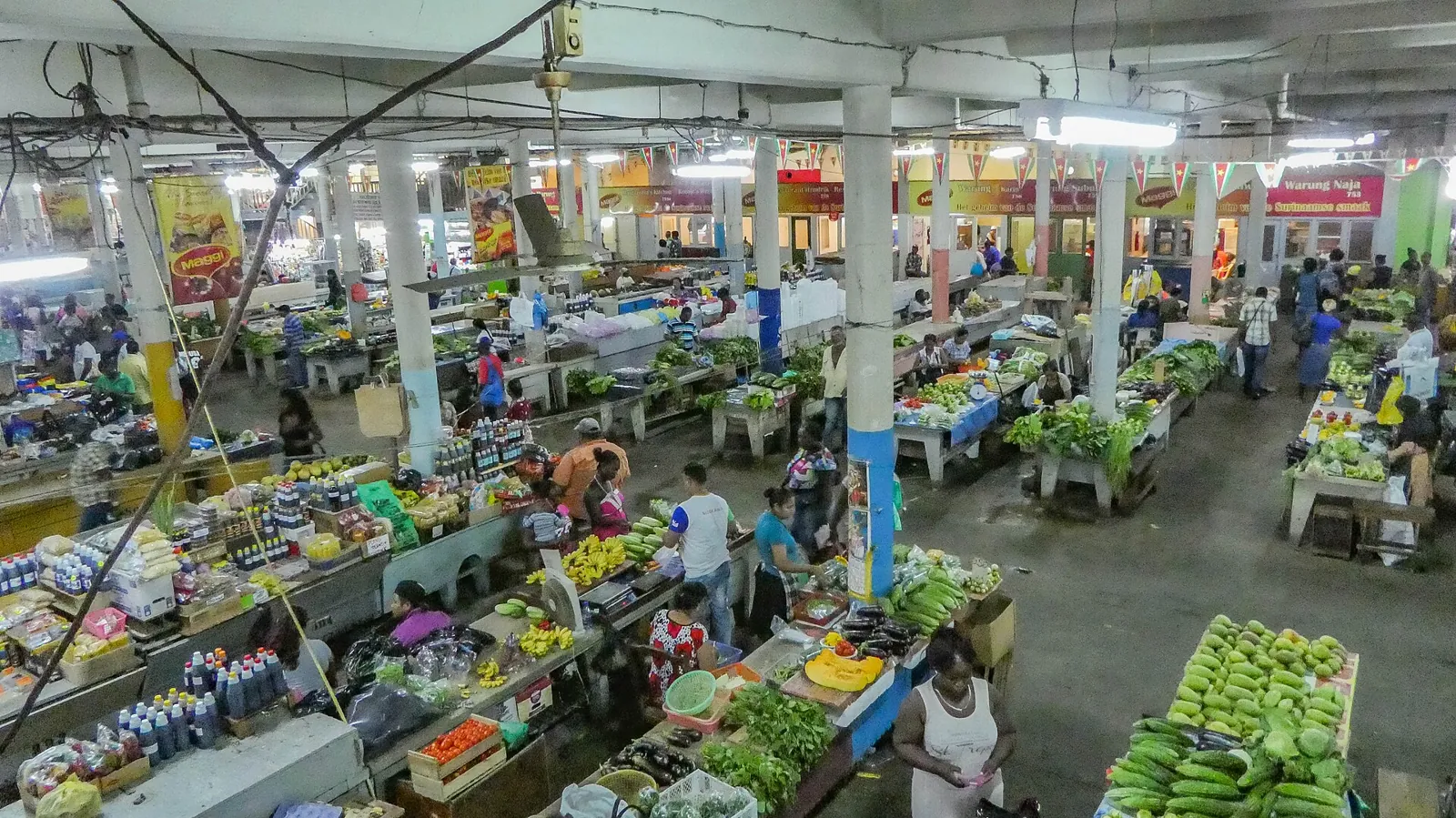
Image credits. Top image: Paramaribo market (33557504165) by -JvL- from Netherlands, CC BY 2.0, via Wikimedia Commons · In-article image: District Commissioner's office in a Diwali atmosphere by Sonysresidence, CC BY-SA 4.0, via Wikimedia Commons
Spotted something out of date or a gift that's no longer available? Tell our editors — we review every correction.




