Diamond jewelry gifts for her: a practical buyer's guide
Which diamond pieces make the best gifts, what the 4Cs actually mean, how lab-grown compares with natural, and what paperwork to insist on.
We independently research every pick. If you buy through our links we may earn a small commission, at no extra cost to you. Affiliate disclosure.
Quick answer
For a diamond gift, start with the piece she will actually wear (studs, a pendant or a band), then set your budget. Judge the stone on the 4Cs, with cut doing the most for sparkle. Decide early between natural and lab-grown, which look the same but differ in origin and price. Ask for an independent grading report, get the paperwork and return policy in writing, and keep the receipt.
- Entry level $250 – $800 (small studs or a solitaire pendant)
- Mid range $800 – $3,000 (larger studs, tennis bracelet, band)
- Must have Written description of the stone, a lab report for larger stones, and a written return policy
Choose the piece before the diamond
The most common gift mistake is falling for a stone before thinking about how she dresses. Look at the jewelry she wears every day: yellow gold, white metal or rose gold; delicate or bold; earrings or necklaces. That tells you the setting and metal, which narrows everything else.
Diamond stud earrings
Why it works: Studs are the classic diamond gift because they suit almost any outfit and need no sizing. Lab-grown studs give a larger look for the same budget.
Skip it if: Her ears are not pierced, or she has a metal sensitivity and you cannot confirm the post metal.
Solitaire or small cluster pendant
Why it works: A single stone on a fine chain is understated enough for daily wear and easy to layer.
Skip it if: She rarely wears necklaces.
Anniversary or eternity band
Why it works: A row of smaller diamonds is a traditional anniversary gift and can be stacked with an existing ring. See our anniversary gifts for more ideas.
Skip it if: You do not know her ring size; full eternity bands are hard to resize.
Tennis or line bracelet
Why it works: A flexible line of matched stones has a big visual impact. Many small diamonds cost far less than one large one of the same total weight.
Skip it if: She works with her hands a lot; check that the clasp has a safety catch.
Diamond-accent pieces
Why it works: Hoops, bar necklaces or rings with tiny accent diamonds add sparkle at a gentle price, which suits birthdays and smaller milestones.
Skip it if: You want a piece with resale or heirloom value; tiny accents are rarely graded individually.
Browse more styles on our jewelry gifts page, or see gifts for your wife and gifts for your girlfriend.
The 4Cs, explained simply
The Gemological Institute of America (GIA) developed the grading system the trade uses to describe diamond quality by four factors: color, clarity, cut and carat weight. Together they determine value, and rarity in any one of them raises the price.
Cut
Cut is about how well a diamond is proportioned and finished, which controls how it returns light. GIA describes a diamond's beauty as brightness (white light), fire (flashes of color) and scintillation (the pattern of light and dark as it moves). As a general rule, a higher cut grade means a brighter stone, so for a gift, cut is the factor most worth spending on. "Cut" is also used loosely for shape: round brilliant, oval, princess, pear, marquise, emerald and heart.
Color
For white diamonds, GIA grades color from D (colorless) to Z (light yellow or brown). The closer to colorless, the rarer and more expensive, and even slight differences change the price. About 35 percent of gem diamonds also show fluorescence under UV light, usually blue; GIA notes strong blue fluorescence can make a slightly yellow stone look whiter, but very strong fluorescence can occasionally make a stone look hazy.
Clarity
Clarity measures internal inclusions and surface blemishes. GIA's scale has 11 grades, from Flawless and Internally Flawless through VVS, VS and SI to Included (I). Flawless stones are extremely rare. GIA notes that diamonds in the middle range, with inclusions visible only under 10x magnification, make up the bulk of the retail market, so you do not need top clarity for a diamond that looks clean to the eye.
Carat weight
One carat is 0.2 grams and is divided into 100 points, so a 50-point stone is half a carat. Price rises faster than weight because large diamonds are rarer. GIA also points out "magic sizes" such as half a carat and one carat: a stone just over the line can cost noticeably more than one just under it, while looking almost identical. Buying slightly under a round number is a classic way to save. Note that the FTC allows fractional weights like "1/2 carat" to cover a range, so ask for the exact decimal weight.
Natural or lab-grown?
Lab-grown diamonds have the same crystal structure as natural diamonds, and GIA says the difference can be indistinguishable by eye. What differs is origin: natural diamonds formed millions to billions of years ago, while lab-grown stones are made in weeks using high-pressure, high-temperature (HPHT) or chemical vapor deposition (CVD) methods. Gem labs can tell them apart with specialized instruments.
The FTC notes that lab-created stones are often less expensive than natural ones, and requires sellers to disclose clearly, right before the word "diamond," that a stone is laboratory-grown or laboratory-created.
Two things to weigh for a gift:
- Budget versus size. Lab-grown lets you buy a larger or higher-grade stone for the same money.
- Long-term value. Treat any diamond gift, and especially a lab-grown one, as something to wear rather than an investment. Ask the jeweler about trade-in or buyback terms if resale matters to you.
Neither is a "fake." Simulants such as cubic zirconia, glass and moissanite are different materials that resemble diamonds; the FTC says imitations must be labeled as such.
Grading reports and certification
For any stone of meaningful size, ask for a grading report from an independent gemological laboratory. GIA reports for natural diamonds list the 4Cs, and you can check a report number on GIA's website. GIA laser-inscribes lab-grown diamonds it examines with the report number and a statement that the stone is laboratory-grown.
In 2025 GIA announced that it would stop using its D-to-Z color and clarity scales for lab-grown diamonds and instead describe them as "premium" or "standard," because the vast majority fall into a narrow quality range. Older lab-grown reports remain valid. Other labs grade lab-grown stones differently, so compare reports from the same lab when comparing prices.
Also ask about treatments. The FTC lists fracture filling and laser drilling as common diamond treatments that improve appearance but can lower value; sellers should tell you about them.
Buy safely: paperwork and returns
- Get the store's refund and return policy in writing before you pay, as the FTC recommends.
- Make sure your receipt lists the stone's origin (natural or lab-grown), weight, any treatments and care requirements; the FTC suggests walking away from a seller who will not put these in writing.
- Ask for a gift receipt and confirm whether engraving or resizing voids returns.
- Check reviews and complaints for the seller before buying, especially online.
- Don't rely on a store's in-house "certificate" alone for a significant purchase.
- Don't assume a stone that passes a basic thermal tester is a diamond; the FTC warns these testers may not detect moissanite.
- Don't pay for top color and clarity grades she will never see in a small earring.
If a purchase goes wrong, the FTC suggests resolving it with the seller first, then reporting to the FTC or your state attorney general; the Jewelers Vigilance Committee also offers mediation.
Frequently asked questions
Which of the 4Cs matters most?
For sparkle, cut. A well-cut stone with modest color and clarity usually looks better than a poorly cut stone with top grades.
Are lab-grown diamonds real diamonds?
Yes. They have the same crystal structure as natural diamonds. They must be sold with a clear "lab-grown" or "laboratory-created" disclosure.
Do I need a GIA report for a gift?
For small accent stones, no. For any single stone where you are paying for specific grades, an independent report is the best protection.
What diamond gift is safest if I don't know her size?
Stud earrings or a pendant. Rings and bangles need accurate sizing.
Sources
- GIA — Diamond Quality Factors. gia.edu
- GIA 4Cs — Simulants, Moissanite and Lab-Grown Diamonds. 4cs.gia.edu
- GIA — GIA to Use New Descriptive Terminology for Laboratory-Grown Diamonds (press release, June 2, 2025). gia.edu
- Federal Trade Commission — Buying Gemstones, Diamonds, and Pearls. consumer.ftc.gov
- Federal Trade Commission — In the Loupe: Advertising Diamonds, Gemstones and Pearls. ftc.gov
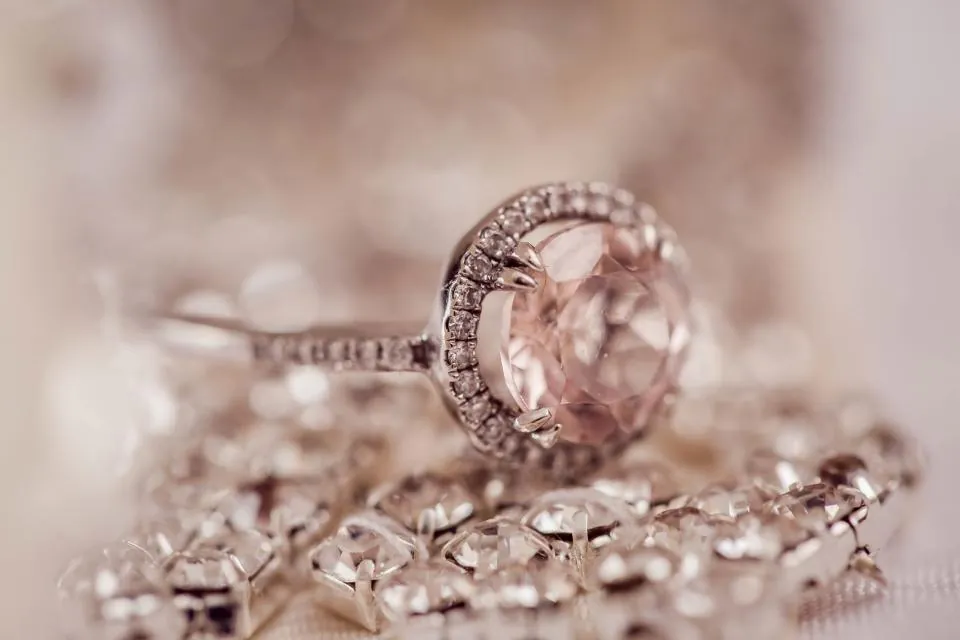
Image credits. Top image: Diamond Ring by Anne Edgar, CC0 1.0, via Stocksnap
Spotted something out of date or a gift that's no longer available? Tell our editors — we review every correction.